

AI-Powered Stroke Tool Linked to Better Outcomes in Large Trial
Medically Reviewed by Dr. Abdul Latif Saad
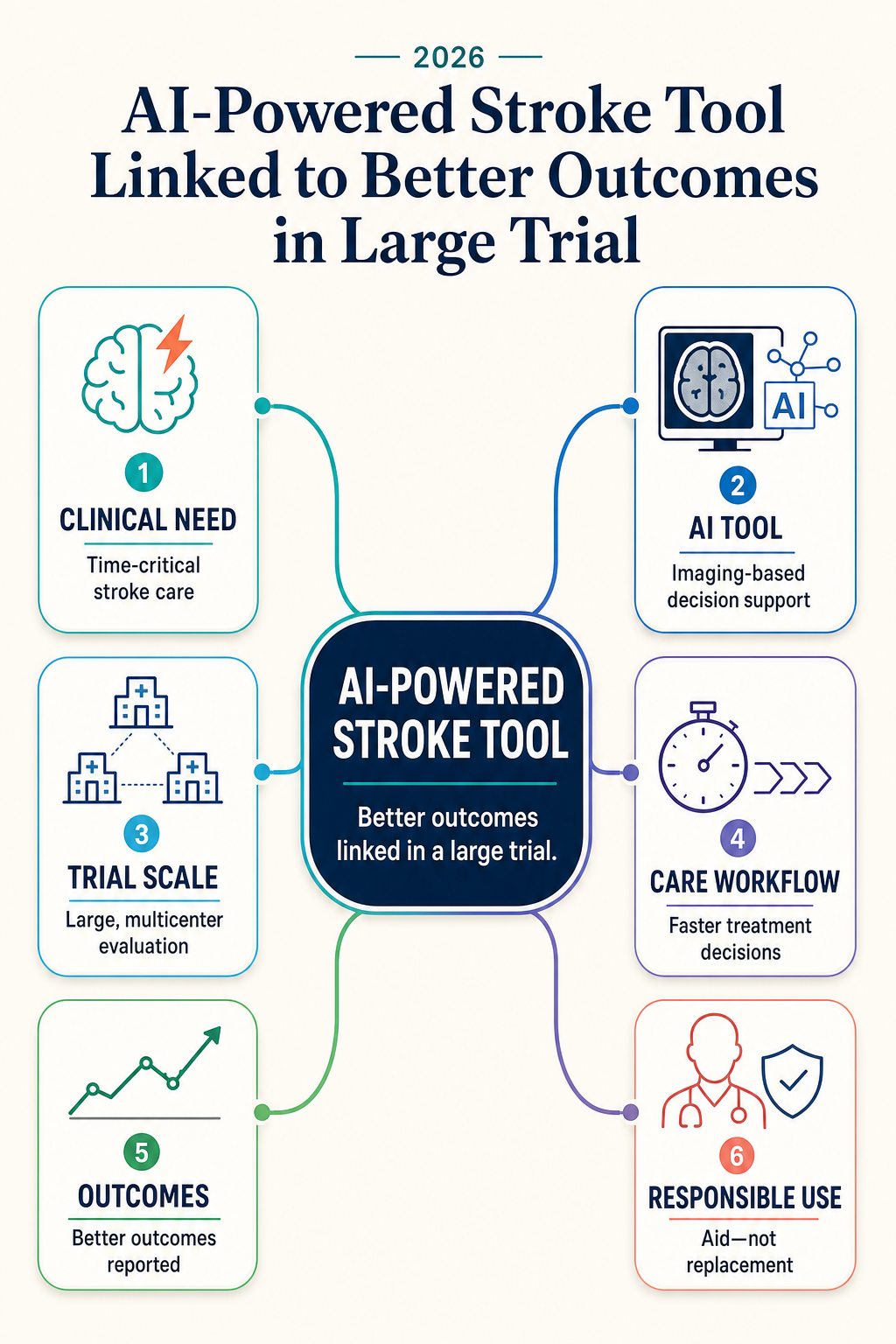
In a large hospital-level trial in China, an AI-assisted stroke decision-support system was associated with fewer reported new vascular events and slightly higher care-quality scores, but it does not replace clinician judgment.
✔ Quick Answer
- The trial included more than 21,000 patients across 77 hospitals in China. [1]
- New vascular events at three months were reported in 2.9% of patients at AI-supported hospitals versus 3.9% at usual-care hospitals. [1]
- At 12 months, reported new vascular-event rates were 4.0% with AI-supported care and 5.5% with usual care; care-quality scores were modestly higher with the system. [1]
- No significant differences were reported in disability, overall mortality, or bleeding complications, but hospital-level randomization and implementation requirements limit generalizability. [1]
Table of Contents
Background: What the AI Stroke Tool Does
The reported trial evaluated an AI-assisted clinical decision-support system (CDSS) for acute ischemic stroke care. The system was intended to support clinical workflows rather than function as an independent clinician. [1]
Functions described in the report
The AI-assisted system analyzed brain scans, helped classify stroke causes, issued reminders for evaluations, and provided treatment recommendations based on clinical guidance. [1]
The source did not identify a specific regulator or regulatory authorization for the system. It also does not support using an algorithm as a substitute for clinical assessment or clinician decision-making. [1]
The New Evidence: Findings From a Large Hospital Trial
Medical News Today reported on a Chinese trial published in The BMJ. Hospitals, rather than individual patients, were assigned to use the AI-supported system or to provide usual care. [1]
AI-supported hospitals
11,054 patients
Patients were treated at 38 hospitals using the AI-assisted decision-support system. [1]
Usual-care hospitals
10,549 patients
Patients were treated at 39 hospitals providing usual care. [1]
Study setting
77 hospitals in China
The study included more than 21,000 patients. [1]
Reported vascular-event outcomes
At three months
New vascular events occurred in 2.9% of patients in the AI-supported group versus 3.9% in the usual-care group. [1]
At 12 months
New vascular events occurred in 4.0% of patients in the AI-supported group versus 5.5% in the usual-care group. [1]
Care quality and measured safety outcomes
The reported overall care-quality score was 91.4% in the AI-supported group and 89.8% in the usual-care group. The report found no significant between-group differences in disability, overall mortality, or bleeding complications at three, six, or 12 months. [1]
How to interpret the findings
In this hospital-level trial, AI-supported care was associated with fewer reported new vascular events and a modestly higher care-quality score. The results alone do not establish that the AI system caused those differences or that the same outcomes would occur in other health systems. [1]
Clinical Implications for Stroke Care
The findings suggest that an AI-supported workflow may assist hospitals with scan analysis, stroke-cause classification, evaluation reminders, and guidance-based treatment recommendations. The reported care-quality score was modestly higher at AI-supported hospitals. [1]
Considerations for clinical teams
- The system was used as decision support during acute ischemic stroke care, not as an autonomous decision-maker. [1]
- Its reminders and recommendations may have contributed to differences in reported care processes, although the study design cannot isolate the effect of any single feature. [1]
- Implementation required integration with hospital information systems, electronic medical records, and picture archiving and communication systems. [1]
- The source identifies possible barriers including interoperability, imaging-standardization issues, technical support needs, workflow disruption, clinician adoption, and limited resources. [1]
Important safety limitation
The absence of significant differences in disability, mortality, or bleeding complications in this trial does not establish that all AI stroke tools are safe or effective in every setting. Performance and implementation may vary by system, hospital infrastructure, workflow, and clinician use. [1]
What this means for patients
The available evidence supports viewing this technology as a tool used within a clinical team. It does not establish that patients should choose a hospital based on whether it uses AI, or that the system will perform similarly outside the studied setting. [1]
Practical Takeaway
For patients and families
If an AI-assisted system is used, patients or families can ask the care team how its information and recommendations are reviewed within the clinical process.
For hospitals
Implementation may require attention to interoperability, imaging standards, technical support, workflow effects, clinician adoption, and available resources. [1]
For clinicians
The reported system was designed to provide clinical decision support. The supplied evidence does not support treating AI output as an automatic instruction or a replacement for clinician judgment. [1]
The narrow conclusion supported by the report is that this AI-assisted CDSS was linked with fewer reported new vascular events and slightly higher care-quality scores in a large Chinese hospital trial, without significant differences in several measured outcomes. [1]
Evidence in Context: Limitations and Unanswered Questions
Study size is important, but the trial design and care setting also affect how the results should be interpreted.
Key limitations
- Hospitals, not individual patients, were randomized: Differences in hospitals, clinicians, care practices, and post-discharge follow-up may have affected outcomes. [1]
- Generalizability is uncertain: The trial was conducted in China, and the reported results may not translate directly to other health systems. [1]
- Implementation requirements were substantial: The system required integration with hospital information systems, electronic medical records, and picture archiving and communication systems. [1]
- Routine-practice evidence remains limited: The report noted that many AI stroke tools have not yet been rigorously evaluated in real-world clinical settings. [1]
What remains unknown
The supplied reporting does not establish whether similar findings would occur in hospitals with different technology infrastructure, staffing, imaging standards, or follow-up practices. It also does not establish that other AI-assisted stroke systems have the same effectiveness or safety profile. [1]
When to See a Doctor
People receiving care for acute ischemic stroke should discuss diagnosis, treatment decisions, monitoring, and follow-up with their healthcare team. Patients and families may ask whether AI-assisted decision support is being used and how clinicians review its recommendations.
AI is not a replacement for clinical care
The reported technology was a hospital-based clinical decision-support system. The supplied evidence does not support relying on an algorithm, website, or home device instead of assessment by a qualified healthcare professional. [1]
This article provides information about a reported clinical trial and does not replace advice from a qualified medical professional.
Frequently Asked Questions
QDid the AI tool reduce disability after stroke?
No significant between-group difference in disability was reported at three, six, or 12 months. The reported differences were fewer new vascular events and a modestly higher overall care-quality score in the AI-supported group. [1]
QDoes this study prove that AI caused better stroke outcomes?
No. The findings show an association in a trial where hospitals, rather than individual patients, were assigned to groups. Differences among hospitals, clinicians, care practices, and follow-up could have influenced the results. [1]
QCan AI replace clinicians in stroke care?
No conclusion in the supplied evidence supports replacing clinicians with AI. The system was described as decision support that analyzed scans, helped classify stroke causes, provided reminders, and offered recommendations based on clinical guidance. [1]
References
- Morales-Brown P. “AI-powered stroke tool linked to improved patient outcomes in large clinical trial.” Medical News Today. Published March 30, 2026. https://www.medicalnewstoday.com/articles/ai-powered-stroke-tool-linked-improved-patient-outcomes-large-clinical-trial