

Allopurinol: Uses, Dosage, Side Effects & Safety
Medically Reviewed by Dr. Abdul Latif Saad
Learn when allopurinol is recommended for gout prevention, how treatment is monitored, and what the supplied evidence does—and does not—say about its safety.
When should allopurinol be used for gout prevention? The 2020 American College of Rheumatology (ACR) guideline strongly recommends urate-lowering therapy for people with tophaceous gout, gout-related radiographic damage, or frequent gout flares. It identifies allopurinol as the preferred first-line urate-lowering therapy, including for people with moderate-to-severe chronic kidney disease (CKD) [1].
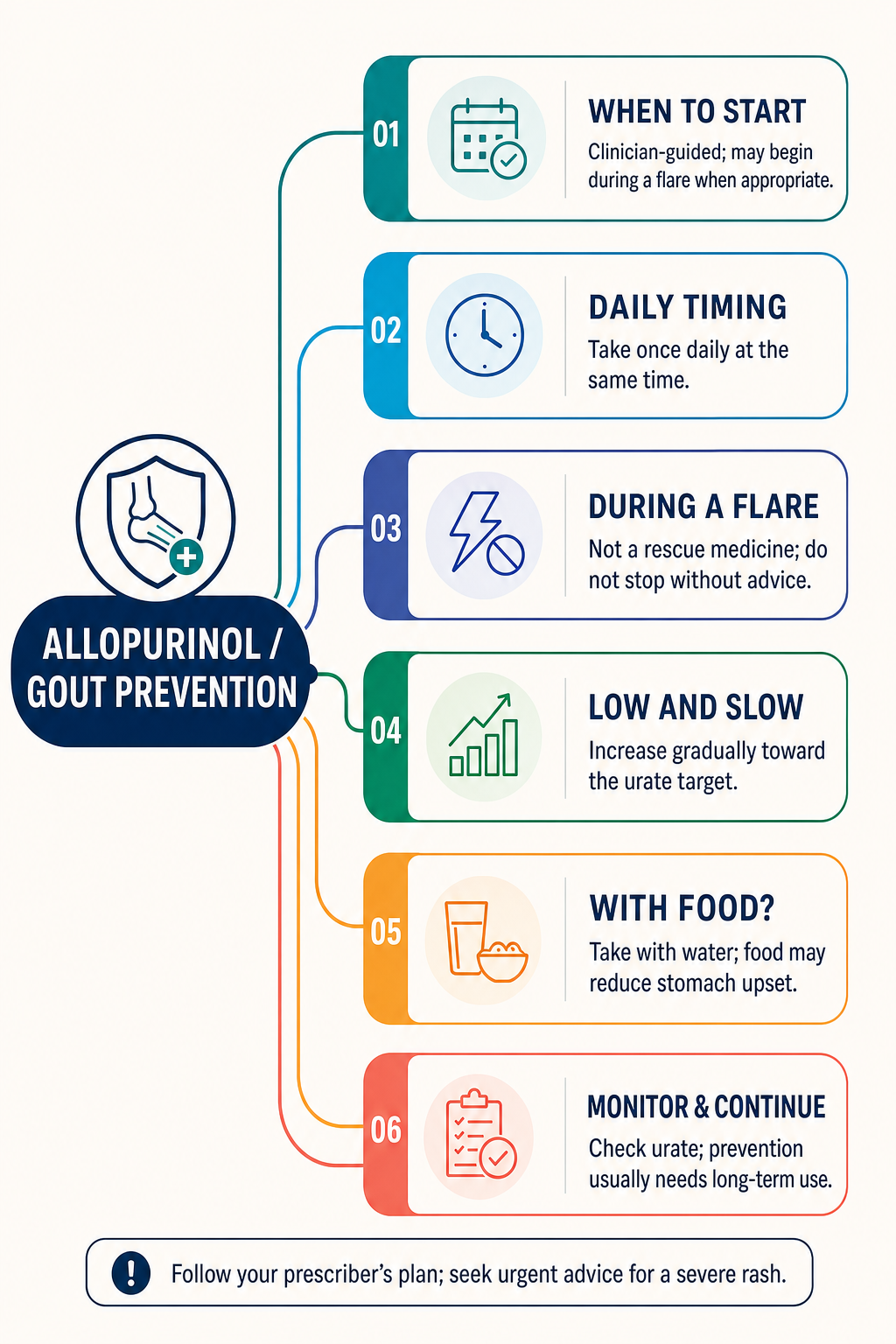
The supplied evidence does not compare morning with evening dosing. Take allopurinol according to the schedule and dose prescribed by the clinician managing your gout; treatment is adjusted using serial serum urate measurements rather than symptoms alone [1].
✔ Key Facts
- ✓ Drug class: Xanthine oxidase inhibitor; urate-lowering therapy
- ✓ Main use: Long-term urate-lowering treatment for selected people with gout
- ✓ Key safety fact: Allopurinol hypersensitivity syndrome risk factors, including HLA-B*58:01 testing, are discussed in CKD-focused literature [2]
- ✓ Key evidence-based fact: The ACR recommends dose titration guided by serial serum urate measurements, with a target below 6 mg/dL [1]
Table of Contents
1. What Is Allopurinol?
Allopurinol is a urate-lowering therapy. The ACR guideline recommends it as the preferred first-line option for gout, including in people with moderate-to-severe CKD [1]. It is used as part of a long-term strategy in which the dose is titrated according to repeat serum urate measurements.
It also has a role in selected patients at risk of tumour lysis syndrome, an oncological emergency in which rapid tumour-cell breakdown can cause hyperuricaemia and other dangerous metabolic abnormalities [3,4]. This is a specialist-directed use and is separate from routine gout prevention.
Allopurinol is a xanthine oxidase inhibitor and a urate-lowering therapy. In the supplied evidence, it is discussed for gout management and as one possible intervention for selected patients at risk of tumour lysis syndrome [1,3,4].
2. How Does Allopurinol Work?
Think of xanthine oxidase as one step in a production line that converts xanthine to uric acid. Allopurinol inhibits this enzyme, reducing uric acid production. In tumour lysis syndrome, this same mechanism can also allow xanthine to accumulate; the clinical usefulness of measuring xanthine to guide allopurinol or rasburicase use remains uncertain [3].
For gout, the ACR recommends a treat-to-target approach: clinicians adjust urate-lowering therapy using serial serum urate values, generally aiming for a serum urate level below 6 mg/dL [1].
3. What Conditions Does It Treat?
For gout, the strongest recommendation for starting urate-lowering therapy applies to people with tophaceous gout, gout-related radiographic damage, or frequent flares [1]. Allopurinol is the ACR-preferred first-line urate-lowering treatment in this setting. In cancer care, allopurinol may be included in risk-based prevention strategies for tumour lysis syndrome, alongside monitoring and hydration and, when appropriate, rasburicase [3,4].
4. Dosage & Administration
The ACR recommends starting allopurinol at a low dose of no more than 100 mg per day, with a lower starting dose in CKD, then titrating treatment using serial serum urate measurements [1]. The supplied sources do not establish a preferred clock time for gout dosing or provide a universal maintenance dose.
| Patient Group | Typical Dose | Frequency | Important Notes |
|---|---|---|---|
| Adults starting allopurinol for gout | Low starting dose of ≤100 mg/day | Follow the prescribed regimen | The ACR recommends subsequent titration guided by serial serum urate measurements [1] |
| People with CKD starting allopurinol | Lower starting dose than 100 mg/day | Follow the prescribed regimen | Allopurinol remains the preferred first-line urate-lowering therapy in moderate-to-severe CKD; individualized monitoring is needed [1,2] |
| Ongoing gout management | Individualized | Follow the prescribed regimen | Use a treat-to-target strategy, generally aiming for serum urate below 6 mg/dL [1] |
| Living kidney donors in one research trial | 300 mg | Once daily for 9 months | This was a trial protocol, not a general gout dosing recommendation [5] |
5. Side Effects
The supplied abstracts do not provide a complete list of allopurinol adverse effects. They do identify hypersensitivity as an important safety consideration and report adverse events in one non-gout clinical trial. Consult the current product information and a clinician for individualized safety advice.
Hypersensitivity syndrome: risk factors for allopurinol hypersensitivity syndrome, including HLA-B*58:01 testing, are reviewed in CKD-focused gout literature [2].
Adverse events in a research setting: in a 9-month trial in living kidney donors, adverse events occurred more often in the allopurinol group than in the placebo group [5].
Severe events in that trial: three adverse events were considered severe, all in the allopurinol group; the abstract does not describe the events [5].
Kidney-related considerations: CKD requires a lower starting dose and careful treatment optimization, but does not by itself exclude allopurinol use [1,2].
Incomplete adverse-effect detail: the provided gout guideline and abstracts do not enumerate common symptoms or their frequencies; product-specific safety information is necessary.
• You develop symptoms that could represent a serious allergic or hypersensitivity reaction after starting allopurinol
• You experience a severe or rapidly worsening illness while taking allopurinol
• A clinician has previously told you that you had a serious reaction to allopurinol
The supplied sources identify allopurinol hypersensitivity syndrome as a safety concern but do not provide a symptom checklist [2].
6. Who Should NOT Take Allopurinol?
⛔ Contraindications & Special Precautions
The supplied evidence does not provide a complete contraindication list. It supports individualized review of kidney function, previous reactions, and factors associated with allopurinol hypersensitivity syndrome. Product labeling and clinician assessment remain necessary before treatment.
Previous serious allopurinol reaction: this history requires clinician review before any future use; hypersensitivity is a recognized safety concern [2].
CKD: CKD is not an automatic reason to avoid allopurinol, but the ACR recommends a lower starting dose and serial urate-guided titration [1].
Potential genetic susceptibility: a CKD review discusses HLA-B*58:01 testing among risk factors considered for allopurinol hypersensitivity syndrome [2].
Uncertain individual risk: the supplied sources do not provide enough information to determine suitability based on other illnesses or concomitant medicines; a prescriber should review these factors.
7. Drug Interactions
| Interacting Drug/Substance | Effect | Management |
|---|---|---|
| Rasburicase | Both are discussed as medications targeting hyperuricaemia in tumour lysis syndrome; the supplied sources do not provide a routine interaction statement [3,4]. | Use only within a specialist-directed tumour lysis syndrome strategy. |
| Colchicine | The ACR recommends anti-inflammatory prophylaxis when urate-lowering therapy is initiated, but the supplied abstract does not describe a pharmacokinetic interaction [1]. | Use prophylaxis only as prescribed by the treating clinician. |
| Nonsteroidal anti-inflammatory drugs | Recommended by the ACR as an option for gout-flare management; no allopurinol interaction details are supplied [1]. | Review appropriateness with a clinician, particularly in CKD. |
| Glucocorticoids | Recommended by the ACR as an option for gout-flare management; no allopurinol interaction details are supplied [1]. | Use according to the clinician’s flare-management plan. |
| Other prescription or non-prescription medicines | The supplied sources do not provide a comprehensive interaction list. | Ask a pharmacist or prescriber to review all medicines and supplements before starting or changing allopurinol. |
8. Pregnancy & Breastfeeding Safety
🤰 During Pregnancy
The supplied sources do not provide pregnancy safety data or a pregnancy recommendation for allopurinol. Discuss the risks and benefits of treatment with an obstetric clinician and the clinician managing gout before starting, stopping, or changing therapy.
🍼 During Breastfeeding
The supplied sources do not provide breastfeeding safety data for allopurinol. A breastfeeding patient should obtain individualized advice from a qualified healthcare professional before using the medicine.
📚 Evidence in Context
The most directly relevant source is the 2020 ACR gout guideline. It recommends allopurinol as preferred first-line urate-lowering therapy, including in moderate-to-severe CKD; low-dose initiation; titration using serial serum urate measurements to a target below 6 mg/dL; and anti-inflammatory prophylaxis for at least 3–6 months when urate-lowering therapy begins [1]. A 2025 CKD review highlights the risk of undertreatment from overly restrictive dosing and discusses “start-low-go-low” optimization and allopurinol hypersensitivity syndrome risk factors, including HLA-B*58:01 testing [2]. A 2026 trial in 71 living kidney donors found that allopurinol lowered uric acid but did not significantly improve left ventricular mass, blood pressure, or insulin sensitivity over nine months; adverse events were more frequent in the allopurinol group [5]. This trial was not a gout-prevention study. Tumour lysis syndrome reviews support allopurinol as one risk-based option in cancer care, not as evidence for routine cardiovascular or kidney protection [3,4].
9. Frequently Asked Questions (FAQ)
Q Should I take allopurinol in the morning or at night?
The supplied evidence does not compare morning and evening dosing. Follow the regimen prescribed by your clinician. For gout prevention, the evidence-supported priority is dose titration using serial serum urate measurements rather than a particular time of day [1].
Q Who is most likely to be offered allopurinol for gout prevention?
The ACR strongly recommends urate-lowering therapy for people with tophaceous gout, gout-related radiographic damage, or frequent gout flares. Allopurinol is the guideline’s preferred first-line urate-lowering therapy, including for people with moderate-to-severe CKD [1].
Q What monitoring goal does the ACR guideline recommend?
The guideline recommends a treat-to-target approach in which urate-lowering therapy is titrated using serial serum urate measurements, generally to a serum urate target below 6 mg/dL [1].
References
- FitzGerald JD, Dalbeth N, Mikuls T, et al. 2020 American College of Rheumatology Guideline for the Management of Gout. Arthritis Rheumatol. 2020;72(6):879–895. doi:10.1002/art.41247. PMID:32390306.
- Ostrowski RA. Gout Management in Patients With CKD: A Review. Am J Kidney Dis. 2025;86(4):516–524. doi:10.1053/j.ajkd.2025.04.020. PMID:40609855.
- Howard SC, Avagyan A, Workeneh B, Pui CH. Tumour lysis syndrome. Nat Rev Dis Primers. 2024;10(1):58. doi:10.1038/s41572-024-00542-w. PMID:39174582.
- Barbar T, Jaffer Sathick I. Tumor Lysis Syndrome. Adv Chronic Kidney Dis. 2021;28(5):438–446.e1. doi:10.1053/j.ackd.2021.09.007. PMID:35190110.
- Langberg NE, Jenssen TG, Hopp E, et al. A Randomized Controlled Trial to Evaluate Allopurinol vs Placebo on Left Ventricular Mass in Living Kidney Donors. Kidney360. Published online August 3, 2026. doi:10.34067/KID.0000001313. PMID:42545761.