


Alogliptin: Uses, Dosage, Side Effects & Safety
Medically Reviewed by Dr. Abdul Latif Saad
Learn what the available evidence says about alogliptin’s role in type 2 diabetes, its mechanism, liver safety, body-composition findings, and important evidence gaps regarding kidney dosing.
Alogliptin is an oral dipeptidyl peptidase-4 (DPP-4) inhibitor used with diet and exercise in the treatment of type 2 diabetes, either alone or with other oral glucose-lowering medicines.[1,2] It works through the body’s incretin system rather than by directly supplying insulin.
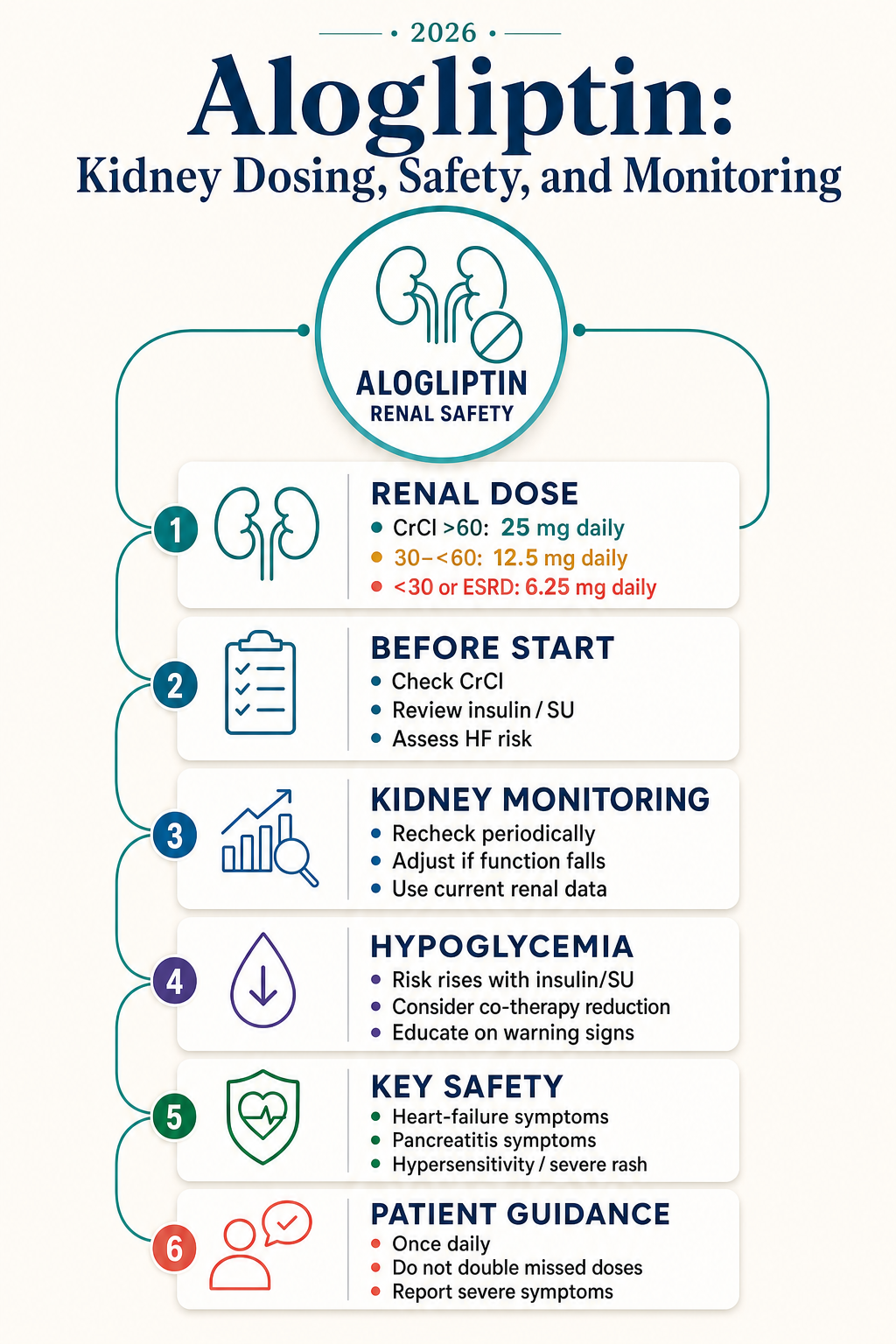
Kidney dosing is often an important practical question, but the supplied sources do not provide a validated renal-dose table, kidney-function thresholds, or monitoring schedule for alogliptin. Individual dosing and kidney monitoring therefore need to come from the current product information and the prescribing clinician.
✔ Key Facts
- ✓ Drug class: Dipeptidyl peptidase-4 (DPP-4) inhibitor
- ✓ Main use: Type 2 diabetes treatment alongside diet and exercise
- ✓ Key safety fact: Rare liver injury has been reported with DPP-4 inhibitors, including alogliptin.[1,2]
- ✓ Key evidence-based fact: Available sources do not establish a kidney-dose regimen; use current prescribing information and clinician guidance.
Table of Contents
1. What Is Alogliptin?
Alogliptin is an oral glucose-lowering medicine in the DPP-4 inhibitor class. LiverTox describes its use with diet and exercise for type 2 diabetes, either as monotherapy or in combination with other oral hypoglycemic agents.[2] A 2011 review reported that clinical studies evaluated daily alogliptin doses of 12.5 mg and 25 mg, but this review is not a substitute for current product labeling or individualized prescribing.[3]
DPP-4 inhibitor; oral glucose-lowering medicine used in type 2 diabetes. The supplied literature does not provide sufficient regulatory-label information to confirm current approved indications, contraindications, or renal-dose instructions.
2. How Does Alogliptin Work?
Think of glucagon-like peptide-1 (GLP-1) as a short-lived meal message. GLP-1 helps increase glucose-dependent insulin secretion. DPP-4 normally breaks down GLP-1; DPP-4 inhibitors reduce that breakdown and raise endogenous circulating GLP-1 activity.[1]
By inhibiting DPP-4, alogliptin supports this incretin pathway and can improve glycemic control in people with type 2 diabetes.[1,3] The supplied sources do not provide a complete clinical interaction or hypoglycemia-risk profile for specific combinations.
3. What Conditions Does It Treat?
The supplied evidence supports alogliptin’s use in the management of type 2 diabetes in combination with diet and exercise.[2] It may be used alone or with other oral glucose-lowering agents. Although a narrative review discusses possible neuroprotective mechanisms in Huntington’s disease, it emphasizes that direct evidence is limited and calls for further experimental and clinical research; this is not an established clinical use.[7]
4. Dosage & Administration
| Patient Group | Typical Dose | Frequency | Important Notes |
|---|---|---|---|
| Adults with type 2 diabetes | Individualized | As prescribed | The supplied sources do not provide a current complete dosing regimen. |
| Participants in a 2011 clinical review | 12.5 mg or 25 mg | Daily | These doses were reported in historical clinical studies and should not be used for self-dosing.[3] |
| Reduced kidney function | Not established from supplied sources | Not established from supplied sources | Obtain the current product information and clinician-directed renal assessment before prescribing or changing a dose. |
| People taking other diabetes medicines | Individualized | As prescribed | Combination treatment requires clinician review of the full regimen. |
5. Side Effects
The supplied safety sources primarily address liver injury. They do not provide a complete frequency-ranked list of common adverse effects for alogliptin.
- Liver injury: Alogliptin has been reported to cause liver injury, although published reports do not clearly define its characteristics or details.[2]
- Cholestatic or mixed liver injury: DPP-4 inhibitors as a class have been linked to rare, generally self-limited cholestatic or mixed liver injury in LiverTox.[1]
- Uncertain full adverse-effect profile: LiverTox notes that the full range of adverse events with DPP-4 inhibitors may not be fully known.[1]
• Symptoms that could suggest significant liver illness, such as yellowing of the skin or eyes, dark urine, or severe unexplained illness.
• A severe reaction occurring after a dose, particularly if urgent medical assessment is needed.
• Any alarming or rapidly worsening symptom while taking alogliptin.
6. Who Should NOT Take Alogliptin?
⛔ Contraindications & Special Precautions
The supplied sources do not contain a complete, current contraindication list. Prescribers should use approved product information and an individual clinical review rather than relying on this summary alone.
Known liver disease or prior suspected drug-related liver injury: Discuss this history with the prescriber because liver injury has been reported with alogliptin and DPP-4 inhibitors.[1,2]
Kidney impairment: Do not assume a standard dose is appropriate. The supplied evidence does not provide renal-dose criteria; clinician review is necessary.
Pregnancy: The supplied sources provide no clinical pregnancy safety data for alogliptin. Seek individualized diabetes and obstetric advice.
Breastfeeding a newborn or preterm infant: LactMed states that an alternative drug may be preferred because clinical breastfeeding information is unavailable.[4]
7. Drug Interactions
| Interacting Drug/Substance | Effect | Management |
|---|---|---|
| Basal insulin | A 2026 observational study included people initiating DPP-4 inhibitors while receiving basal insulin, but it did not provide a drug-interaction safety conclusion for alogliptin.[6] | Have the full diabetes regimen reviewed by the prescribing clinician. |
| Other oral glucose-lowering medicines | Alogliptin may be used with other oral hypoglycemic agents; specific interaction effects were not detailed in the supplied sources.[2] | Do not add, stop, or substitute medicines without professional advice. |
| GLP-1 receptor agonists | The supplied comparative studies do not establish a direct pharmacologic interaction with alogliptin.[5,6] | Ask a clinician whether the combination is appropriate for the individual treatment plan. |
| SGLT-2 inhibitors | The supplied comparative studies do not establish a direct pharmacologic interaction with alogliptin.[5,6] | Use only under a clinician-directed diabetes plan. |
8. Pregnancy & Breastfeeding Safety
🤰 During Pregnancy
The supplied sources do not provide an FDA pregnancy category, pregnancy-label assessment, or clinical pregnancy safety data for alogliptin. Anyone who is pregnant or planning pregnancy should seek prompt individualized advice from their diabetes and obstetric care teams.
🍼 During Breastfeeding
LactMed reports no available information on clinical alogliptin use during breastfeeding. An alternative may be preferred, especially while nursing a newborn or preterm infant; if maternal therapy is used, LactMed advises monitoring the breastfed infant’s blood glucose.[4]
📚 Evidence in Context
The supplied evidence supports alogliptin as a DPP-4 inhibitor used with diet and exercise in type 2 diabetes and explains its incretin-based mechanism.[1,2] A 2011 review described HbA1c reductions of approximately 0.4% to 0.8% with 12.5 mg or 25 mg daily monotherapy in the studies it reviewed, but this older summary does not answer current renal-dosing questions.[3] A 2026 network meta-analysis associated alogliptin with fat-mass gain relative to metformin and exenatide, while DPP-4 inhibitors overall showed neutral lean-body-mass effects.[5] Liver injury appears rare in the DPP-4 class, but the published details for alogliptin remain limited.[1,2] Importantly, the supplied material does not provide a kidney-dose table, specific kidney monitoring intervals, or a complete adverse-effect and interaction profile.
9. Frequently Asked Questions (FAQ)
Q Does this article provide alogliptin doses for different levels of kidney function?
No. The supplied sources do not include renal-function thresholds or a validated kidney-dose regimen. A clinician should use current prescribing information and an up-to-date kidney assessment to determine whether and how dosing should be adjusted.
Q What is known about alogliptin and liver safety?
LiverTox reports that liver injury has been described with alogliptin, but the characteristics and details have not been well defined in published literature.[2] For DPP-4 inhibitors as a class, reported liver injury is described as rare and generally mild.[1] New symptoms suggestive of liver illness require prompt clinical assessment.
Q Does alogliptin cause weight gain or treat Huntington’s disease?
A 2026 network meta-analysis found that alogliptin was associated with fat-mass gain relative to metformin and exenatide, but this comparison does not prove that every person taking alogliptin will gain weight.[5] Huntington’s disease research remains exploratory; the available review calls for further studies and does not establish alogliptin as a treatment for Huntington’s disease.[7]
References
- National Institute of Diabetes and Digestive and Kidney Diseases. Dipeptidyl Peptidase-4 Inhibitors. LiverTox: Clinical and Research Information on Drug-Induced Liver Injury. Updated January 3, 2018. PMID: 31643671. https://pubmed.ncbi.nlm.nih.gov/31643671/
- National Institute of Diabetes and Digestive and Kidney Diseases. Alogliptin. LiverTox: Clinical and Research Information on Drug-Induced Liver Injury. Updated January 3, 2018. PMID: 31643598. https://pubmed.ncbi.nlm.nih.gov/31643598/
- Tanabe A, Kaku K. Alogliptin. Nihon Rinsho. 2011;69(5):871-876. PMID: 21595274. https://pubmed.ncbi.nlm.nih.gov/21595274/
- National Library of Medicine. Alogliptin. Drugs and Lactation Database (LactMed®). Updated May 15, 2026. PMID: 29999685. https://pubmed.ncbi.nlm.nih.gov/29999685/
- Rakhsha SS, Shahinfar H, Ebrahimi-Mousavi S, et al. Comparative Effects of Antidiabetic Drugs on Body Composition: A Systematic Review and Network Meta-Analysis. Diabetes Obes Metab. 2026;28(9):7689-7704. doi:10.1111/dom.70957. PMID: 42304171. https://pubmed.ncbi.nlm.nih.gov/42304171/
- Lipska KJ, Zawack K, Yan L, et al. Comparative Effectiveness of Glucagon-like Peptide-1 Receptor Agonists Versus Oral Agents for Insulin Discontinuation in Type 2 Diabetes: A Target Trial Emulation. Ann Intern Med. 2026. doi:10.7326/ANNALS-25-05216. PMID: 42441965. https://pubmed.ncbi.nlm.nih.gov/42441965/
- Choudhary G, Vashisht K, Sharma V, et al. From glycemic control to neuroprotection: alogliptin as a repurposed candidate for Huntington’s disease. Metab Brain Dis. 2026;41(1):169. doi:10.1007/s11011-026-01942-5. PMID: 42474536. https://pubmed.ncbi.nlm.nih.gov/42474536/
Medical disclaimer: This medication guide is for general education and does not replace advice from a doctor, pharmacist, or other qualified healthcare professional. Do not start, stop, or change alogliptin without professional guidance, particularly if you have kidney disease, liver disease, are pregnant, or are breastfeeding.