


Carcinoid Syndrome: Causes, Symptoms & Treatment
Medically Reviewed by Dr. Abdul Latif Saad
Understand how hormone-producing neuroendocrine tumors can cause diarrhea, flushing, breathing symptoms, and heart-valve disease—and why atypical symptoms need prompt specialist evaluation.
Carcinoid syndrome is an uncommon complication of some well-differentiated neuroendocrine tumors (NETs). The tumor may release serotonin and other mediators into the bloodstream, producing symptoms that can involve the gut, skin, airways, circulation, and heart. [5][10]
The presentation is not always classic. Persistent watery diarrhea, weight loss, swelling, or unexplained right-sided heart-valve disease may be prominent even when flushing or bronchospasm is absent. [1]
✔ Quick Summary
- ✓ Carcinoid syndrome occurs when a well-differentiated NET releases serotonin and other peptides or mediators into the bloodstream. [5]
- ✓ Watery diarrhea, flushing, tachycardia, shortness of breath, bronchospasm, and low blood pressure are recognized features, but not every person develops all of them. [3][5][10]
- ✓ Chronic mediator exposure can affect the right-sided heart valves, causing carcinoid heart disease and symptoms of right-sided heart failure. [1][10]
- ✓ Twenty-four-hour urinary 5-HIAA, imaging, and tumor pathology are important parts of evaluation; somatostatin analogues are central treatments for symptom control. [1][5][9]
Table of Contents
1. What Is Carcinoid Syndrome?
Carcinoid syndrome describes signs and symptoms caused by a carcinoid tumor or another well-differentiated NET that secretes serotonin and other peptides into the bloodstream. These tumors commonly arise in the gastrointestinal tract, although pulmonary carcinoids are also well-differentiated neuroendocrine tumors. [5][9]
Having a carcinoid tumor does not automatically mean a person has carcinoid syndrome. One review states that about 10% of people with carcinoid tumors experience the syndrome, while ENETS guidance reports symptoms of carcinoid syndrome in around 30% of patients with small-intestinal NETs. These figures describe different tumor populations. [5][7]
Carcinoid syndrome may occur without obvious flushing or bronchospasm. In a 2026 case report, chronic watery diarrhea and severe isolated tricuspid regurgitation were the key clues. [1]
2. How Does Carcinoid Syndrome Develop?
Well-differentiated NETs can release serotonin and other biologically active mediators. These substances can affect intestinal activity, blood vessels, airways, and the cardiovascular system, contributing to diarrhea, flushing, hypotension, tachycardia, and bronchospasm. [3][5][10]
For gastrointestinal NETs, carcinoid syndrome is often seen when metastatic disease involves the liver, allowing tumor products to reach the systemic circulation. Prolonged exposure to circulating mediators can produce plaque-like fibrous changes on heart valves, particularly the tricuspid and pulmonary valves. The resulting valve dysfunction can lead to edema, ascites, and right-sided heart failure. [1][10]
Evidence supplied for this article does not establish universal everyday dietary or activity triggers for symptom episodes. However, procedures and surgery require careful planning because uncontrolled mediator release can lead to carcinoid crisis with hemodynamic instability, bronchospasm, and arrhythmias. [3]
3. Causes of Carcinoid Syndrome
Carcinoid syndrome is caused by a hormone-producing carcinoid tumor or another well-differentiated NET. The syndrome reflects the tumor’s secretion of serotonin and other peptides or vasoactive mediators, not a dietary intolerance or routine gastrointestinal infection. Gastrointestinal tumors, especially small-intestinal NETs, are an important setting for the syndrome; liver metastases can increase systemic exposure to tumor products. Pulmonary carcinoid tumors are another type of well-differentiated NET. [5][7][9]
4. Risk Factors
⚠️ Who Is Most at Risk?
Risk is chiefly related to the presence, location, hormonal activity, and extent of a well-differentiated NET. Symptoms alone cannot predict who has the syndrome, and presentations may be atypical. The features below are clinical contexts associated with greater concern for carcinoid syndrome or its complications. [1][5][7][10]
A known well-differentiated NET: Carcinoid syndrome is caused by secretory carcinoid tumors or other well-differentiated NETs. [5]
Small-intestinal NET: ENETS guidance reports carcinoid-syndrome symptoms in around 30% of patients with small-intestinal NETs. [7]
Liver metastases: Metastatic liver involvement is an important clinical setting in which tumor mediators may reach the systemic circulation. [1][5]
Elevated urinary 5-HIAA: Markedly elevated 5-HIAA reflects serotonin excess and has been associated with carcinoid heart disease. [1]
Established carcinoid syndrome: Continuing exposure to tumor mediators can be associated with right-sided valve disease. [10]
Persistent diarrhea: Ongoing watery diarrhea can lead to volume depletion, weight loss, and electrolyte abnormalities. [1]
Planned surgery or invasive procedures: Carcinoid crisis is a peri-procedural concern that requires multidisciplinary planning. [3]
5. Signs & Symptoms
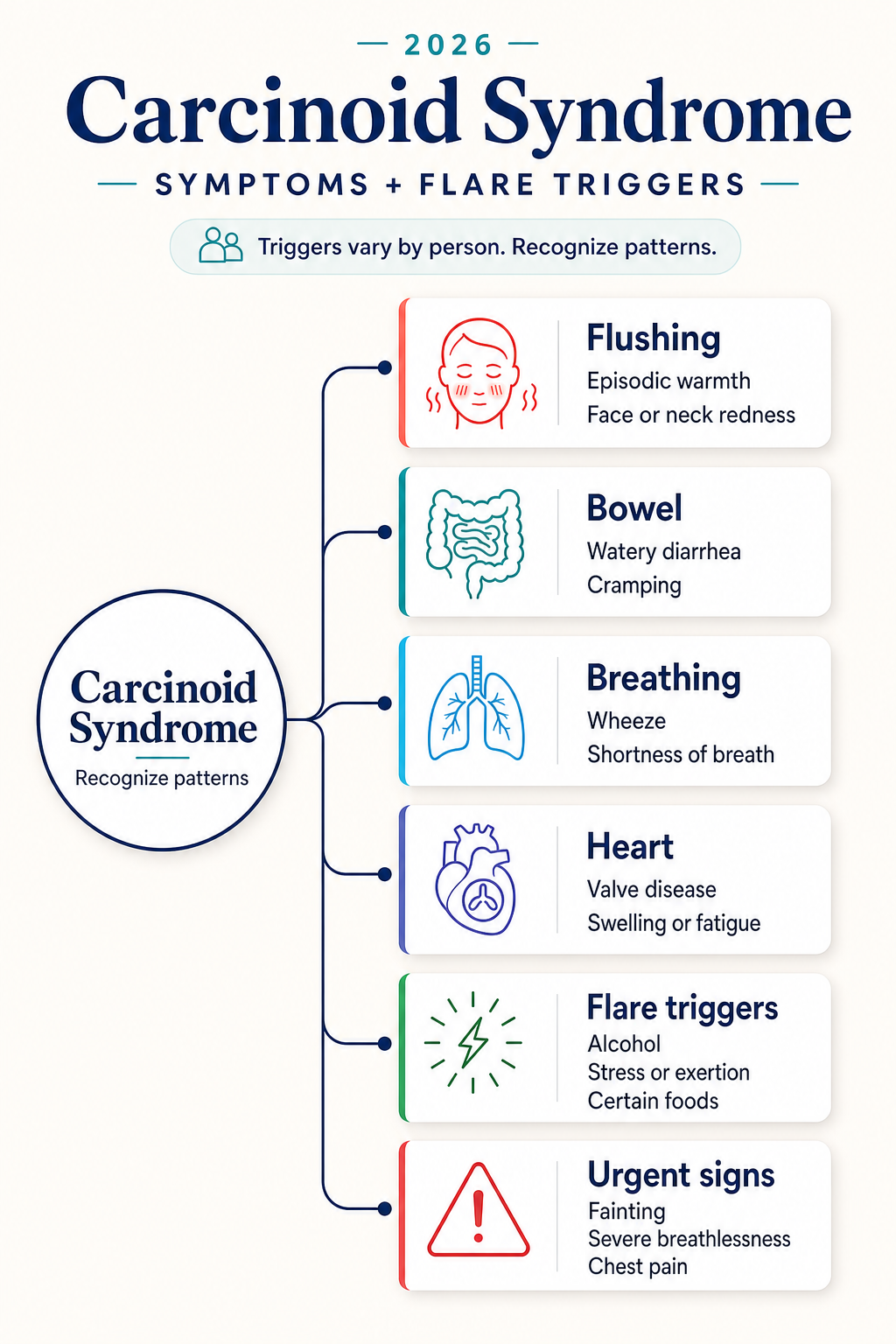
Symptoms vary in type and severity. Some people have episodic vasomotor or breathing symptoms, while others have persistent diarrhea or signs of carcinoid heart disease. Not having flushing does not rule out the syndrome. [1][3][5]
- Watery diarrhea: Persistent or recurrent watery stools are a recognized presentation and can contribute to volume depletion, weight loss, and electrolyte disturbance. [1][10]
- Facial flushing: Flushing is a common finding and reflects the vascular effects of tumor mediators. [5]
- Tachycardia: A rapid heartbeat may occur as part of the syndrome’s vasomotor presentation. [5]
- Shortness of breath: Breathlessness is a reported feature and may also occur with cardiac involvement. [5][10]
- Bronchospasm or wheezing: Some people develop airway tightening as part of episodic carcinoid symptoms or carcinoid crisis. [3][10]
- Hypotension: Low blood pressure can occur with vasomotor symptoms and can be severe during carcinoid crisis. [3][10]
- Unintentional weight loss: Weight loss may accompany chronic diarrhea and advanced NET disease. [1]
- Leg swelling or abdominal fluid: Edema and ascites can result from right-sided heart failure caused by carcinoid-related valve dysfunction. [10]
6. How Is Carcinoid Syndrome Diagnosed?
Evaluation starts with the symptom history, medication history, and physical examination, followed by biochemical assessment and tumor staging. Clinicians assess for diarrhea, flushing, breathing symptoms, weight change, dehydration, edema, and features suggesting right-sided heart involvement. When a NET is identified, pathology is required to confirm and classify the tumor. [1][5][7][9]
- Clinical history and examination: Recurrent diarrhea, flushing, tachycardia, respiratory symptoms, weight loss, edema, and signs of right-sided heart failure may raise concern. [1][3][5][10]
- Twenty-four-hour urinary 5-HIAA: This test measures a serotonin breakdown product. An elevated result supports serotonin excess in the appropriate clinical context. [1][5]
- Serum chromogranin A: This tumor-associated marker may be elevated in NETs and is interpreted with the clinical picture and imaging. [1][5][9]
- Cross-sectional imaging: CT can identify masses, mesenteric disease, liver lesions, and other evidence relevant to tumor staging. [1][9]
- Somatostatin-receptor imaging: Functional imaging is important for staging and treatment-related decisions in small-intestinal NETs and may help assess metastatic disease. [7][9]
- Echocardiography: An echocardiogram assesses valve structure and function when carcinoid heart disease is suspected. [1][10]
- Biopsy and pathology: Tissue examination confirms the underlying NET and determines tumor differentiation and grade. [1][9]
There is no single test that independently confirms every aspect of carcinoid syndrome. Urinary 5-HIAA is a key biochemical test for serotonin excess, while tissue pathology is required to confirm and classify the underlying neuroendocrine tumor. Imaging and echocardiography define disease extent and complications. [1][5][9]
7. Differential Diagnosis
🔎 Conditions That Can Look Similar
Individual symptoms of carcinoid syndrome are not specific. Persistent diarrhea, flushing, respiratory symptoms, electrolyte abnormalities, edema, and valve disease may have other explanations. Clinicians consider the overall pattern and whether there is evidence of a serotonin-secreting NET or carcinoid-related heart-valve disease. [1][5][10]
8. Treatment Options
Treatment depends on symptom burden, tumor site and extent, biochemical activity, heart involvement, and overall clinical circumstances. Management decisions should be made through an experienced multidisciplinary team; ENETS guidance recommends specialist expertise for small-intestinal NET care. [7][10]
🏥 A. First-Line (Gold Standard) Treatment
Somatostatin analogues are a central initial treatment for carcinoid-syndrome symptom control. In pulmonary carcinoid guidance, they are described as first-line treatment for carcinoid syndrome and may also be considered for antiproliferative treatment in selected unresectable pulmonary carcinoids. [5][9]
💊 B. Pharmacological Therapies
- Somatostatin analogues: These treatments are used to control hormone-mediated carcinoid-syndrome symptoms. [5][9]
- Octreotide: Octreotide was used in a reported case with chronic diarrhea, hyponatremia, edema, liver lesions, and carcinoid heart disease. [1]
- Tumor-directed treatment: Depending on the NET and its progression, specialist teams may consider surgery, peptide receptor radionuclide therapy, everolimus, locoregional therapy, or other cancer-directed options. [5][7][9]
- Management of heart involvement: Medical care for carcinoid heart disease is focused on symptom control and palliation; valve surgery may be considered for selected symptomatic patients with controlled metastatic carcinoid syndrome. [10]
🏠 C. Supportive & Lifestyle Management
Clinical monitoring, dietary management, and medication review are included in initial management discussions for carcinoid syndrome. Report persistent diarrhea, weight loss, swelling, or symptoms suggesting dehydration promptly. Before surgery or invasive procedures, ensure the treating team knows about carcinoid syndrome because carcinoid crisis can cause distributive shock, bronchospasm, and arrhythmias. [3][5]
📚 9. Evidence in Context
The supplied evidence supports biochemical assessment, staging imaging, pathology confirmation of the underlying NET, somatostatin analogues for symptom control, and multidisciplinary care. ENETS 2024 guidance supports specialist multidisciplinary decision-making for small-intestinal NETs. Important evidence limitations remain: several supplied publications are reviews, expert guidance, or case reports. The 2026 case report illustrates an atypical presentation but cannot establish how often it occurs. Evidence in this source set does not define universal lifestyle flare triggers, so individualized advice should come from the treating team. [1][5][7][9][10]
10. When to Seek Emergency Medical Help
• You develop confusion, collapse, profound weakness, or signs of severe low blood pressure.
• You have sudden severe shortness of breath, wheezing, or bronchospasm.
• You develop a fast or irregular heartbeat with severe symptoms.
• Persistent diarrhea is accompanied by marked dizziness, very little urine, or inability to keep fluids down.
• You have rapidly worsening swelling, abdominal fluid, or breathlessness that may reflect right-sided heart failure.
• During surgery or an invasive procedure, you develop abrupt hemodynamic instability, bronchospasm, or arrhythmia, which can occur with carcinoid crisis. [1][3][10]
11. Frequently Asked Questions (FAQ)
Q Can carcinoid syndrome occur without flushing?
Yes. Flushing and bronchospasm are recognized features, but they may be absent. Chronic watery diarrhea, electrolyte disturbance, weight loss, or unexplained right-sided valve disease can still warrant evaluation for carcinoid syndrome in the appropriate setting. [1]
Q Are there proven everyday flare triggers for carcinoid syndrome?
The supplied evidence does not establish a universal list of food, drink, or activity triggers. Procedures and surgery are important settings because uncontrolled mediator release can cause carcinoid crisis; patients should discuss symptom patterns and peri-procedural planning with their specialist team. [3]
Q Can carcinoid syndrome damage the heart?
Yes. Carcinoid heart disease can cause plaque-like fibrous changes on the heart valves, particularly the tricuspid and pulmonary valves. Valve dysfunction may lead to edema, ascites, and right-sided heart failure; echocardiography is used when heart involvement is suspected. [1][10]
References
- Kothia D, et al. Carcinoid syndrome revealed by chronic diarrhea and isolated severe tricuspid regurgitation. JCEM Case Reports. 2026. PubMed
- Ross JS, et al. Clinical Responses to Tarlatamab Among Patients with Pulmonary Carcinoid. Journal of Thoracic Oncology. 2026. PubMed
- Centellas-Ibáñez SD, Fernández-Rivera BJ. Anesthesia in carcinoid syndrome for tricuspid and pulmonary valve replacement: case report. Archivos de Cardiología de México. 2026. PubMed
- Keppel S, et al. Transcatheter Tricuspid Valve Replacement in Carcinoid Heart Disease With Transjugular 3D Intracardiac Echocardiography Guidance. JACC Case Reports. 2026. PubMed
- Mackenzie J, et al. Cutaneous Manifestations of Carcinoid Tumor and Syndrome. Clinical Dermatology. 2026. PubMed
- Ito T, Lee L, Jensen RT. Carcinoid-syndrome: recent advances, current status and controversies. Current Opinion in Endocrinology, Diabetes and Obesity. 2018;25(1):22-35. PubMed
- Lamarca A, et al. European Neuroendocrine Tumor Society (ENETS) 2024 guidance paper for the management of well-differentiated small intestine neuroendocrine tumours. Journal of Neuroendocrinology. 2024;36(9):e13423. PubMed
- Pan IW, et al. A Systematic Review of Economic and Quality-of-Life Research in Carcinoid Syndrome. PharmacoEconomics. 2021;39(11):1271-1297. PubMed
- Caplin ME, et al. Pulmonary neuroendocrine (carcinoid) tumors: European Neuroendocrine Tumor Society expert consensus and recommendations for best practice for typical and atypical pulmonary carcinoids. Annals of Oncology. 2015;26(8):1604-1620. PubMed
- Hassan SA, et al. Carcinoid heart disease. Heart. 2017;103(19):1488-1495. PubMed