


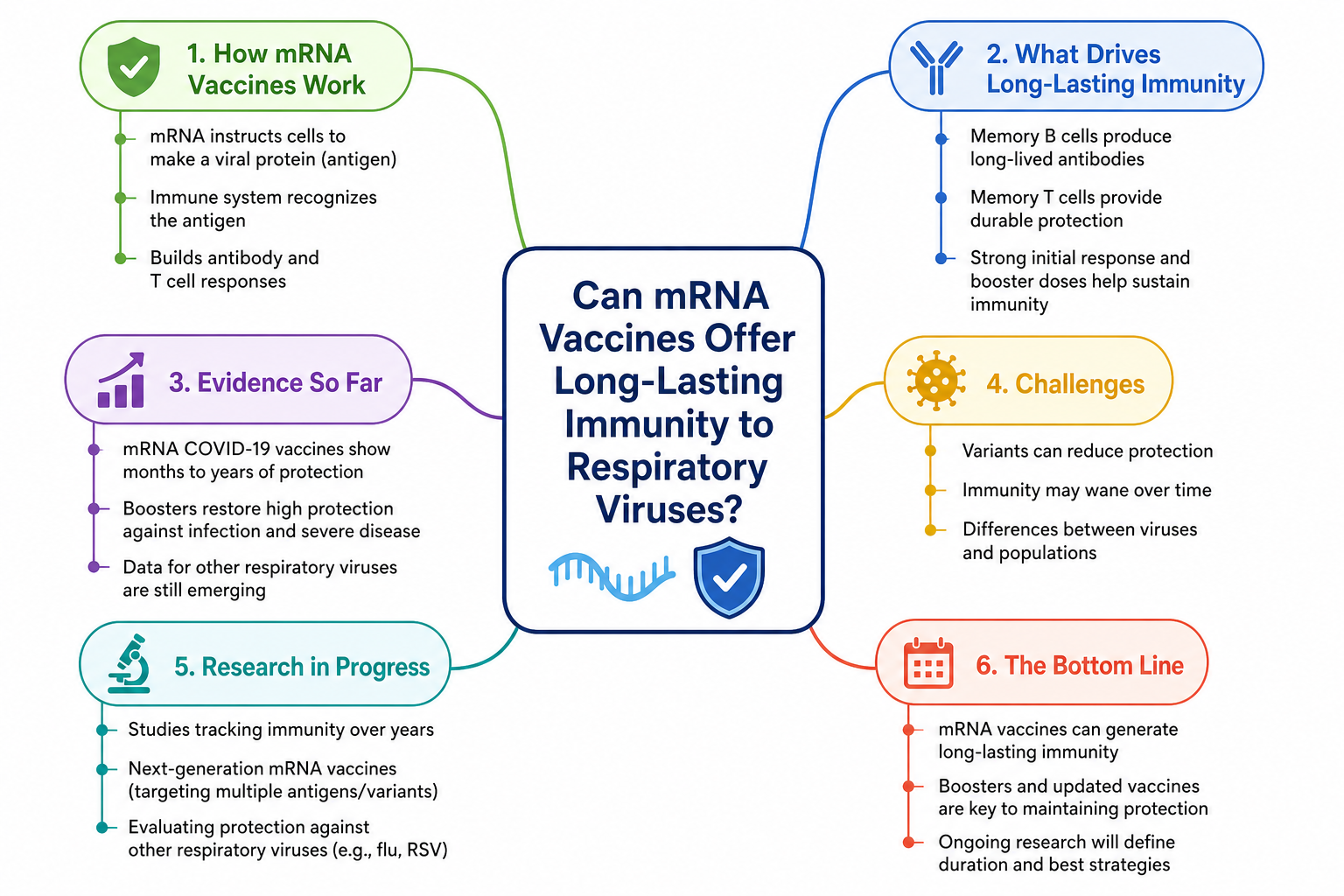
Can mRNA Vaccines Offer Long-Lasting Immunity to Respiratory Viruses?
Emerging evidence from self-amplifying mRNA platforms, nanotechnology-driven nanovaccines, and inhalable delivery systems suggests that next-generation mRNA vaccines may be capable of generating durable, tissue-specific immunity against respiratory pathogens — though critical translational challenges remain.
✔ Quick Answer
- ✅ Self-amplifying mRNA (SAM) platforms offer long-lasting antigen expression and flexible antigen combinations, making them promising candidates for both respiratory and bacterial pathogens [1].
- ✅ Nanotechnology-enhanced mRNA–lipid nanoparticle systems are under preclinical investigation for RSV and other respiratory viruses, with data showing enhanced antigen stability and immunogenicity [2].
- ✅ Inhalable mRNA vaccines hold potential for long-lasting, tissue-specific memory responses and immediate local protection, but immune persistence and formulation stability remain unresolved [3].
- ✅ A live-attenuated RSV vaccine candidate demonstrated long-lasting neutralising antibodies in cotton rats and protection in a rhesus macaque, providing a useful immunological benchmark for mRNA platforms [4].
📋 Table of Contents
- Background: Why Durable Respiratory Immunity Is Difficult to Achieve
- The New Evidence: What Recent Studies Tell Us
- Self-Amplifying mRNA: A Dose-Sparing Approach to Multivalent Immunity
- Nanotechnology-Driven mRNA Vaccines for RSV and Respiratory Pathogens
- Inhalable mRNA Vaccines: Targeting Immunity at the Source
- Benchmarking Against Live-Attenuated Vaccines
- Clinical Implications: What This Means for Patients and Clinicians
- Evidence in Context: Limitations and Open Questions
- When to Consult a Doctor
- Frequently Asked Questions
- References
Background: Why Durable Respiratory Immunity Is Difficult to Achieve
Respiratory viruses — including Respiratory Syncytial Virus (RSV), influenza, SARS-CoV-2, and Monkeypox virus (MPXV) — continue to impose significant global health burdens. A central challenge in respiratory vaccinology is not simply generating an immune response, but sustaining it long enough to provide meaningful real-world protection.
The respiratory tract is an immunologically complex environment. Pathogens typically enter through mucosal surfaces, where systemically generated immunity from intramuscular injections may be slower to act. Truly effective respiratory vaccines likely need to elicit both systemic antibody responses and durable local mucosal immunity — a dual requirement that traditional platforms have struggled to fulfil simultaneously [3].
📖 Key Definition: What Is Immunological Memory?
Immunological memory is the ability of the immune system to respond more rapidly and robustly upon re-exposure to a previously encountered pathogen. Long-lasting vaccine-induced immunity requires the generation of memory B cells (which produce antibodies), memory T cells, and — ideally for respiratory pathogens — tissue-resident memory cells in the lung and airway mucosa.
The global success of mRNA COVID-19 vaccines demonstrated that this platform can rapidly induce strong immune responses. However, questions about the duration of mRNA vaccine-induced immunity — and how to extend it — remain at the frontier of vaccine science. This article synthesises the latest published evidence on whether mRNA technology can be engineered to deliver not just rapid, but truly long-lasting protection against respiratory viruses.
The New Evidence: What Recent Studies Tell Us
Four lines of recent scientific inquiry illuminate the current state of mRNA-based immunity for respiratory and mucosal pathogens: self-amplifying mRNA constructs, nanotechnology-enhanced delivery systems, inhalable vaccine formulations, and comparative immunological benchmarks from live-attenuated vaccine research.
Self-Amplifying mRNA: A Dose-Sparing Approach to Multivalent Immunity
One of the most compelling recent advances is the development of self-amplifying mRNA (SAM) platforms. Unlike conventional mRNA vaccines, which encode only the antigen of interest, SAM constructs incorporate a viral replicase sequence that allows the mRNA to replicate within the host cell, producing higher levels of antigen from a smaller initial dose [1].
A 2025 study published in Vaccine by Chen et al. evaluated SAM vaccine designs against Neisseria meningitidis group B (MenB), a bacterium with a complex antigenic landscape. While MenB is not a respiratory virus, the immunological principles demonstrated have broader applicability to respiratory vaccine design. The researchers constructed and compared several multivalent SAM configurations encoding four distinct antigens: factor H binding protein (fHbp), Neisseria Heparin-Binding Antigen (NHBA), Neisserial adhesin A (NadA), and Porin A (PorA) [1].
The study found that a mixed-delivery approach — where individually encapsulated mRNA–lipid nanoparticles (LNPs) were combined prior to administration (the “PreMix” strategy) — outperformed a tandem fusion construct in which all four antigens were encoded in a single mRNA. The PreMix formulation elicited a serum bactericidal assay (SBA) titer of 1:256 at a 5 µg dose, compared to a titer of only 1:32 with the tandem construct [1].
SAM-PreMix (Mixed Delivery)
SBA titer of 1:256 at 5 µg dose. Superior antigen expression and immunogenicity. Strong humoral and cellular immune responses observed at a 1 µg dose. Favourable manufacturing profile [1].
SAM Tandem Construct (SAM-SP2)
SBA titer of 1:32 at equivalent dose. Limited in vitro expression, though still capable of inducing immune responses in mice. Less optimal for multivalent antigen delivery [1].
Dose-Sparing Advantage
Strong humoral and cellular immune responses were induced at a low dose of 1 µg, underscoring the dose-sparing potential of the SAM platform — a critical advantage for pandemic preparedness [1].
For respiratory vaccine design, this research highlights a crucial principle: how antigens are combined in mRNA vaccines matters profoundly. For applications requiring multivalent coverage — such as multiple influenza strains or RSV subtypes A and B — the SAM platform’s capacity for flexible antigen combinations while maintaining strong immunogenicity is directly relevant [1]. The authors specifically describe the SAM platform as offering “long-lasting expression,” addressing one of the central questions about mRNA vaccine durability [1].
Nanotechnology-Driven mRNA Vaccines for RSV and Respiratory Pathogens
A 2025 review published in Colloids and Surfaces B: Biointerfaces by Niculescu et al. surveyed nanotechnology-driven vaccines for two pathogens of respiratory relevance: RSV and MPXV [2].
RSV is the leading cause of acute lower respiratory tract infections in young children globally and a major cause of morbidity in elderly adults [4]. The review documents several nanotechnology platforms under development for RSV, including mRNA–lipid nanoparticles, nanocages, virus-like particles, elastin-like polypeptides, and self-aggregating lipopeptides [2]. Each platform aims to enable precise antigen presentation that stimulates both mucosal and systemic immunity.
The review authors note that nanoparticle-based vaccines can mimic viral structures, facilitating targeted interactions with antigen-presenting cells (APCs), optimising antigen presentation, and promoting strong cellular and humoral immune responses [2]. For respiratory viruses, the capacity to engage APCs in mucosal tissues — including dendritic cells lining the airways — is important for generating long-lived tissue-resident memory.
💡 Why Lipid Nanoparticles Matter for Respiratory Immunity
Lipid nanoparticles (LNPs) are the delivery vehicles used in currently approved mRNA vaccines. For respiratory applications, LNP formulations must be engineered for compatibility with pulmonary biology — including mucus penetration, surfactant interactions, and uptake by airway epithelial cells and alveolar macrophages. Current research is exploring LNP compositions specifically optimised for inhalation delivery [2, 3].
The Niculescu et al. review emphasises that despite promising preclinical findings, no approved MPXV or RSV nanovaccines are currently available as of their 2025 publication [2]. Critical barriers to clinical translation include the need for further characterisation of nanoparticle safety and immunogenicity, scalable manufacturing, and identification of optimal viral antigens for targeting [2].
Inhalable mRNA Vaccines: Targeting Immunity at the Source
Delivering mRNA vaccines directly to the respiratory tract via inhalation has the potential to generate not only systemic antibodies but also local mucosal immunity — including secretory IgA and tissue-resident memory T cells — at the exact site where respiratory pathogens first establish infection.
A 2022 roadmap article in Current Opinion in Biotechnology by Roh, Fromen, and Sullivan outlined both the promise and the challenges of this approach [3]. The authors note that mRNA vaccines offer “exceptional efficacy and versatile capacity to be adapted to new viruses and variants,” but identify “critical questions regarding immune persistence and formulation stability” as major unresolved issues [3]. They frame inhalable mRNA vaccines as a “significant opportunity” to drive “long-lasting, tissue-specific memory responses needed for rapid recall and immediate local protection” [3], while identifying three major translational challenges:
Challenge 1: Aerosol and Lung Stability
mRNA and LNP formulations must withstand the physical stresses of aerosolisation and remain intact after pulmonary deposition, which exposes them to surfactant proteins and enzymatic degradation [3].
Challenge 2: Pulmonary Biological Barriers
The respiratory tract presents multiple barriers to effective vaccine delivery, including mucus layers, mucociliary clearance, and alveolar macrophage surveillance, all of which can reduce delivery efficiency [3].
Challenge 3: Predictive Models
There is currently a lack of validated predictive models and measurement techniques that accurately recapitulate in vivo pulmonary immunology, making preclinical-to-clinical translation more uncertain [3].
Benchmarking Against Live-Attenuated Vaccines: The RSV Immunological Standard
To contextualise the durability potential of mRNA-induced immunity, it is useful to consider what conventional vaccine platforms have achieved. A 2021 study in the Journal of Virology by Jenkins et al. evaluated a live-attenuated RSV (LAV) vaccine candidate — rgRSV-L(G1857A)-G(L208A) — containing two targeted mutations: one in the S-adenosylmethionine (SAM) binding site of the viral mRNA cap methyltransferase within the large (L) polymerase protein, and another in the G attachment protein that inhibits its cleavage during production in Vero cells [4].
This LAV candidate efficiently induced neutralising antibodies that were long lasting in cotton rats, provided complete protection from RSV challenge, and protected a rhesus macaque from RSV challenge without causing enhanced disease [4]. It demonstrated the ability to stimulate both B and T cell responses by presenting the full viral protein repertoire to the immune system — a property intrinsic to live-attenuated approaches [4].
🧪 What Is a Live-Attenuated Vaccine?
Live-attenuated vaccines (LAVs) use weakened but live forms of a pathogen. By presenting the full complement of viral proteins, LAVs can stimulate broad B and T cell responses and immunological memory. They have been used successfully for decades against measles, mumps, rubella, and varicella. However, they carry risks in immunocompromised individuals and are more complex to manufacture than mRNA vaccines [4].
The Jenkins et al. findings establish that durable, long-lasting neutralising antibody responses against RSV following low-dose immunisation are immunologically achievable. The outstanding question for mRNA platforms is whether they can replicate this durability — particularly given that the SAM platform claims “long-lasting expression” as a mechanistic feature [1] and that inhalable mRNA delivery routes are being designed to generate tissue-resident memory comparable to live-attenuated approaches [3].
Clinical Implications: What This Means for Patients and Clinicians
Taken together, the current body of evidence supports a cautiously optimistic picture for mRNA-based long-lasting respiratory immunity, with important caveats for clinical practice.
For Clinicians
SAM and nanoparticle platforms are still predominantly in preclinical or early clinical stages for respiratory viruses. No MPXV or RSV nanovaccines have yet received regulatory approval [2]. Booster strategies remain part of guidance for currently approved mRNA respiratory vaccines.
For High-Risk Patients
Elderly patients, immunocompromised individuals, and infants — the primary RSV burden groups [4] — stand to benefit most from vaccines with extended durability. The dose-sparing potential of SAM vaccines may also be relevant for populations where lower-dose immunisation is preferred [1].
For Pandemic Preparedness
The modular, rapidly adaptable nature of mRNA platforms remains a strategic advantage for emerging respiratory threats. The ability to encode multiple antigens within a SAM framework offers potential for broad-coverage respiratory vaccines [1, 2].
Practical Takeaway: A Decision Framework
For healthcare professionals advising patients on respiratory vaccine options, the following framework reflects the current evidence base:
📋 Practical Decision Guide
- ▶️ Currently approved mRNA vaccines for COVID-19 and RSV offer proven safety and efficacy — clinicians should follow updated booster schedules as immune waning has been observed with current formulations.
- ▶️ SAM platform vaccines demonstrate dose-sparing and enhanced immunogenicity in preclinical models [1] — Phase I/II trial results in respiratory-specific pathogens should be monitored as they emerge.
- ▶️ Inhalable mRNA vaccines remain at early development stages with significant translational hurdles [3] — they are not yet a clinical option.
- ▶️ Patients at highest risk for severe respiratory disease (elderly, infants, immunocompromised) should receive currently available effective vaccines while next-generation platforms progress through the clinical pipeline [4].
Evidence in Context: Limitations and Open Questions
🔍 Study Limitations and Research Gaps
- Predominantly preclinical data: The SAM vaccine immunogenicity data from Chen et al. [1] were generated in mouse models. Translation to human immune responses — particularly regarding durability — cannot be assumed without clinical trial data.
- No approved respiratory nanovaccines: Despite extensive preclinical promise, Niculescu et al. [2] explicitly note that no MPXV or RSV nanovaccines have received clinical approval, highlighting a considerable gap between preclinical efficacy and clinical translation.
- Immune persistence unresolved for inhalable mRNA: Roh et al. [3] specifically flag that “critical questions remain regarding immune persistence” for inhaled mRNA formulations — the central question this article addresses remains only partially answered.
- Animal model extrapolation: The long-lasting antibody data for the RSV LAV candidate [4] were generated in cotton rats and a single rhesus macaque. Larger controlled non-human primate studies and human trials are necessary to confirm durability.
- Manufacturing scalability: Both nanotechnology-based [2] and inhalable [3] mRNA vaccine platforms face significant challenges in scalable, reproducible manufacturing — a critical prerequisite for global deployment.
When to Consult a Doctor
While next-generation mRNA vaccine science continues to advance, patients should consult their healthcare provider in the following circumstances:
- If you are over 60 years of age or have underlying lung disease (COPD, asthma), heart disease, diabetes, or immunosuppression — these groups are at highest risk of severe RSV and influenza disease and should discuss currently available vaccine options promptly.
- If you are a parent of an infant or young child — RSV is the leading cause of acute lower respiratory tract infections in children under five years globally [4], and vaccine guidance is rapidly evolving.
- If you have questions about the durability of your current respiratory vaccines and whether booster doses are recommended for your age group and health profile.
- If you are interested in participation in clinical trials for next-generation mRNA or inhalable respiratory vaccines — your physician or a local academic medical centre can advise on eligibility.
Frequently Asked Questions
Q What makes self-amplifying mRNA vaccines potentially more durable than conventional mRNA vaccines?
Self-amplifying mRNA (SAM) vaccines incorporate viral replicase sequences that allow the mRNA to replicate inside host cells, resulting in higher and more prolonged antigen expression from a smaller initial dose. Chen et al. describe this as providing “long-lasting expression” — a key mechanistic advantage over conventional mRNA vaccines, where antigen production diminishes more rapidly as the mRNA is degraded [1]. Whether this translates into proportionally longer-lasting immunological memory in humans remains to be confirmed in clinical trials.
Q Why is the inhalation route considered important for long-lasting respiratory immunity?
Respiratory viruses infect through the mucosal surfaces of the airways. Intramuscular vaccines primarily generate systemic immunity — circulating antibodies and memory cells in blood and lymphoid organs. Inhaled mRNA vaccines have the potential to stimulate tissue-resident memory T cells and secretory IgA directly in the lungs and airways — the exact site of infection. Roh et al. describe this as the ability to drive “long-lasting, tissue-specific memory responses needed for rapid recall and immediate local protection” [3], though formulation and stability challenges must first be overcome.
Q Are there any approved mRNA-based nanovaccines for RSV or other respiratory viruses beyond COVID-19?
mRNA-based RSV vaccines have received regulatory approval in some jurisdictions. However, the broader category of advanced nanotechnology-enhanced nanovaccines for RSV — including platforms such as nanocages, virus-like particles, and elastin-like polypeptide systems described in current research — had not received clinical approval as of the Niculescu et al. 2025 review [2]. These platforms remain under active preclinical and early clinical investigation. Patients should consult their healthcare provider or national immunisation programme guidelines for the most current information on approved RSV vaccines.
📚 References
- Chen G, Chen G, Wang S, Xing R, Yang Y, Zhou R, et al. Modular design of a self-amplifying mRNA vaccine for multivalent immunization against Neisseria meningitidis B. Vaccine. 2025 Dec 5;68:127964. doi: 10.1016/j.vaccine.2025.127964. PMID: 41205400.
- Niculescu AG, Dumitrascu AM, Koçer AT, Arayıcı PP, Yuka SA, Koçer S, et al. Nanotechnology-driven enhancement and modulation of immune responses in monkeypox and respiratory syncytial virus nanovaccine research. Colloids Surf B Biointerfaces. 2025 Oct;254:114829. doi: 10.1016/j.colsurfb.2025.114829. PMID: 40450846.
- Roh EH, Fromen CA, Sullivan MO. Inhalable mRNA vaccines for respiratory diseases: a roadmap. Curr Opin Biotechnol. 2022 Apr;74:104-109. doi: 10.1016/j.copbio.2021.10.017. PMCID: PMC9064875. PMID: 34894574.
- Jenkins T, Wang R, Harder O, Xue M, Chen P, Corry J, et al. A Novel Live Attenuated Respiratory Syncytial Virus Vaccine Candidate with Mutations in the L Protein SAM Binding Site and the G Protein Cleavage Site Is Protective in Cotton Rats and a Rhesus Macaque. J Virol. 2021 Jan 13;95(3):e01568-20. doi: 10.1128/JVI.01568-20. PMCID: PMC7925107. PMID: 33177201.