


Cold Agglutinin Disease: Causes, Symptoms & Treatment
Medically Reviewed by Dr. Abdul Latif Saad
This guide explains how cold agglutinin disease causes anemia and cold-triggered symptoms, how it is diagnosed, and which treatments are supported by current evidence.
Cold agglutinin disease, or CAD, is a rare form of autoimmune hemolytic anemia. In CAD, the immune system makes cold-reactive antibodies that attach to red blood cells and trigger complement-mediated damage, which can lead to anemia and circulation-related symptoms in exposed body parts [3,7,8,9,10].
The condition can be confusing at first. Why do symptoms worsen in cold weather? Why does the blood bank care so much about temperature? And which treatments help CAD specifically, rather than other kinds of autoimmune anemia? Here is the evidence-based overview.
✔ Quick Summary
- ✓ Cold agglutinin disease is a cold-antibody autoimmune hemolytic anemia usually driven by IgM autoantibodies and classical complement pathway activation [3,7,10].
- ✓ Symptoms can include fatigue, shortness of breath, pallor, jaundice, dark urine, and cold-induced color change or discomfort in fingers, toes, ears, or nose [3,7,8,10].
- ✓ Diagnosis relies on evidence of hemolysis plus a direct antiglobulin test; in typical CAD, monospecific testing is usually C3d positive [7,8,9].
- ✓ For patients who need treatment, expert recommendations support rituximab-based therapy; selected cases may also benefit from C1s inhibition with sutimlimab, while steroids should not be used to treat CAD according to a 2021 expert review [9,10].
Table of Contents
1. What Is Cold Agglutinin Disease?
Cold agglutinin disease is a subtype of autoimmune hemolytic anemia in which cold-reactive antibodies, usually IgM, bind to red blood cells and activate the classical complement pathway, causing hemolysis [3,7,10]. CAD is generally distinguished from cold agglutinin syndrome (CAS), which is a similar process that occurs secondary to another condition such as infection or a lymphoid malignancy [3,7]. This distinction matters because treatment may need to target either the primary CAD-associated B-cell process or an underlying secondary cause.
In typical CAD, the direct antiglobulin test is usually positive for C3d only, a pattern that helps separate it from warm autoimmune hemolytic anemia [7,8,9].
2. How Does Cold Agglutinin Disease Develop?
In CAD, IgM antibodies bind to red blood cells more readily at lower temperatures, especially in cooler peripheral tissues such as the fingers, toes, ears, and nose [3,7,10]. Once these antibodies bind, they activate complement. That complement activity is a major driver of hemolysis and anemia [3,7,10]. Expert review also describes CAD pathogenesis as having two linked components: an underlying clonal B-cell lymphoproliferation that produces the pathogenic antibody, and the complement-mediated hemolysis that causes many of the symptoms clinicians treat [10].
3. Causes of Cold Agglutinin Disease
CAD is an immune-mediated blood disorder, not simply poor circulation or cold sensitivity. The immediate cause is production of cold-reactive autoantibodies that activate complement on red blood cells [3,7,10]. Doctors also need to determine whether the presentation is true primary CAD or cold agglutinin syndrome related to another disorder, because infections and lymphoid malignancies can cause a similar cold-antibody hemolytic picture [3,7,8].
4. Risk Factors
⚠️ Who Is Most at Risk?
Risk in CAD is driven more by underlying hematologic or immune biology than by everyday habits. The literature points clinicians toward B-cell lymphoproliferative disease, secondary triggers such as infection, and situations where cold exposure reveals otherwise subtle disease [3,7,10]. Practical risk also rises during procedures that expose blood to cooler temperatures or extracorporeal circuits [5].
Clonal B-cell lymphoproliferative disease: primary CAD is linked to an underlying B-cell process that produces pathogenic antibody [10].
Lymphoid malignancy: chronic lymphocytic leukemia and other lymphoid cancers can cause secondary cold agglutinin syndrome [3].
Recent or concurrent infection: infections are recognized secondary causes of cold agglutinin syndrome [3,7].
Cold exposure: this does not cause CAD itself, but it can trigger antibody binding, red cell agglutination, and symptoms [3,5,7].
History suggesting another hemolytic anemia subtype: mixed AIHA, warm AIHA, and other causes must be considered during evaluation [7,8,9].
Procedures involving cooled blood handling: apheresis, cell processing, transfusion support, or similar interventions may require extra precautions in active disease [5].
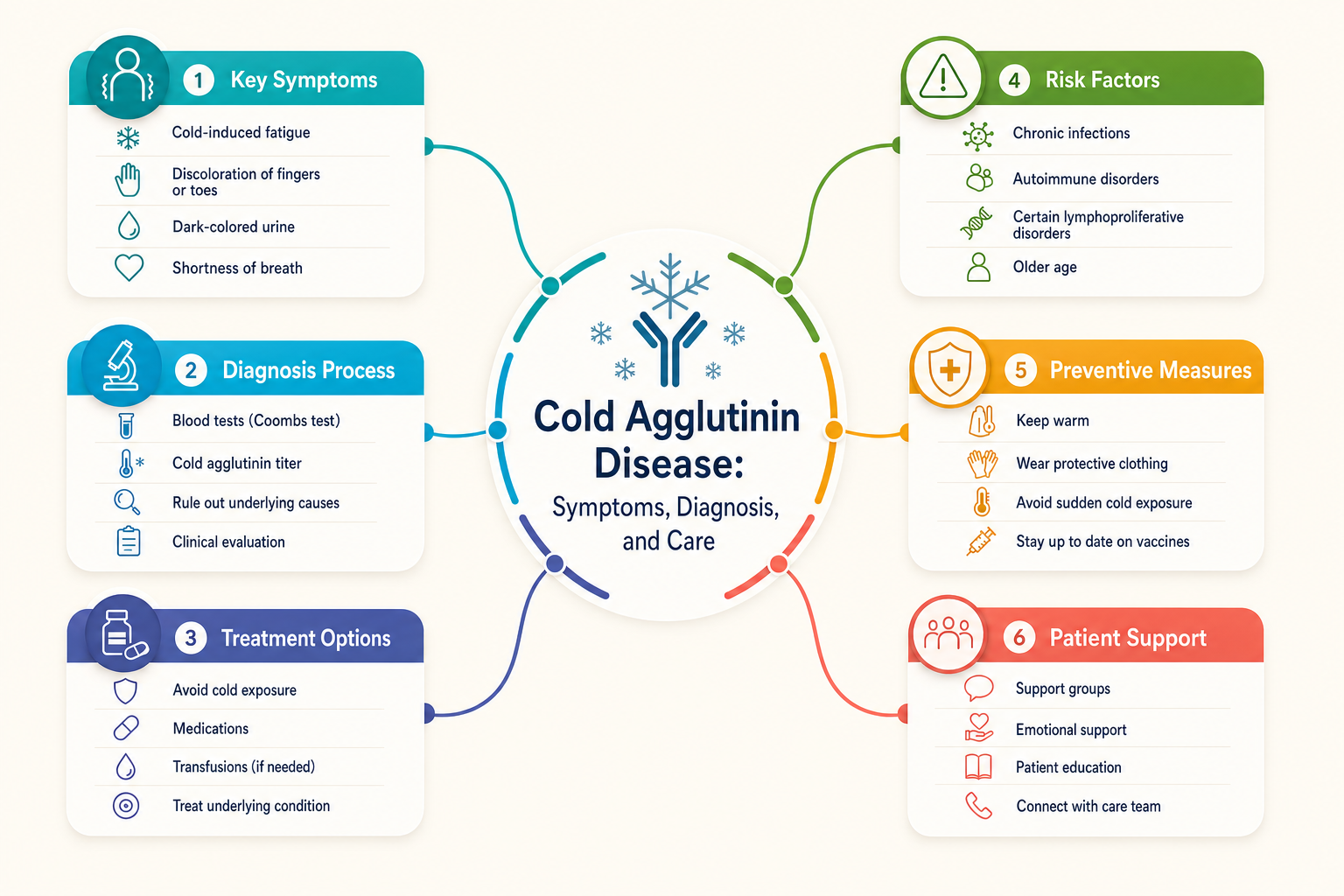
5. Signs & Symptoms
Symptoms reflect both hemolytic anemia and cold-triggered circulatory effects [3,7,10].
Fatigue: anemia lowers oxygen delivery to tissues, leaving patients drained or weak [3,7,10].
Shortness of breath or reduced exercise tolerance: this can happen when falling hemoglobin limits oxygen transport [7,10].
Pallor: pale skin or mucosa may appear when anemia is clinically significant [7,8].
Jaundice: breakdown of red blood cells can raise bilirubin and yellow the eyes or skin [7,8].
Dark urine: this may be a clue that hemolysis is active [7,8].
Cold-induced pain, numbness, or discomfort in fingers, toes, ears, or nose: cooler temperatures promote antibody binding and red cell agglutination [3,7,10].
Bluish or dusky discoloration of exposed areas: peripheral circulation can be affected when blood cools [3,7,10].
Symptoms worsening in cold weather or during temperature-sensitive procedures: this is a practical hallmark of the disease [5,7].
6. How Is Cold Agglutinin Disease Diagnosed?
🔬 Differential Diagnosis & Investigations
Diagnosis starts by confirming hemolytic anemia and then identifying the mechanism. That step is essential because warm AIHA, mixed AIHA, paroxysmal cold hemoglobinuria, drug-induced hemolysis, and nonimmune hemolytic disorders can overlap clinically [7,8,9]. The central laboratory test is the direct antiglobulin test with monospecific testing, combined with evaluation for secondary causes such as infection or lymphoid malignancy [3,7,8,9].
The key confirmatory investigation is the direct antiglobulin test (DAT) with monospecific testing. In typical CAD, the DAT is usually positive for C3d only, showing complement deposition on red blood cells and helping distinguish CAD from warm AIHA and other hemolytic conditions [7,8,9].
7. Treatment Options
Treatment depends on whether symptoms are mild or severe, whether anemia is clinically important, and whether the condition is primary CAD or secondary cold agglutinin syndrome. Not every patient needs medication, but bothersome symptoms or symptomatic anemia usually justify treatment [9,10].
🏥 A. First-Line (Gold Standard) Treatment
For patients with CAD who require therapy, the First International Consensus Meeting recommends rituximab with or without bendamustine in the first line [9]. Berentsen’s expert review similarly states that B-cell directed therapy should remain the first choice in most patients, with bendamustine plus rituximab offering durable responses but often slower onset, while rituximab alone may be preferable in frail patients [10].
💊 B. Pharmacological Therapies
- Rituximab: a B-cell directed monoclonal antibody used to reduce pathogenic antibody production; supported by consensus recommendations for CAD needing treatment [9,10].
- Bendamustine plus rituximab: targets the underlying B-cell clone and is described in expert review as highly efficacious and often durable, although response can take months [10].
- Sutimlimab: a C1s inhibitor that blocks the classical complement pathway and can rapidly control hemolysis; evidence includes expert review and a published case report in secondary cold agglutinin syndrome [3,10].
- Therapy for secondary disease: if the picture is cold agglutinin syndrome, treatment should be directed toward the underlying cause, such as infection or lymphoid malignancy; one 2026 case report described sutimlimab used as a bridge alongside obinutuzumab-venetoclax for chronic lymphocytic leukemia-associated disease [3].
🏠 C. Supportive & Lifestyle Management
Keeping warm is foundational, because cold can trigger red cell agglutination and worsen symptoms [7]. During transfusion, apheresis, stem cell collection, surgery, or other blood-handling procedures, teams may need environmental warming, insulated tubing, or prewarmed equipment [5]. Also important: a 2021 expert review states that corticosteroids should not be used to treat CAD [10].
📚 Evidence in Context
The supplied evidence consistently describes CAD as an IgM-driven, complement-mediated autoimmune hemolytic anemia in which diagnosis depends on careful serology and exclusion of secondary causes [3,7,8,9,10]. The strongest practice-shaping sources here are the international consensus recommendations and the 2021 expert review, which support rituximab-based B-cell therapy for many patients who need treatment and emphasize that steroids are not effective treatment for CAD [9,10]. Evidence for sutimlimab is promising for rapid control of hemolysis, but part of the supplied support comes from expert review and case-based experience rather than head-to-head comparative trials [3,10]. Procedural evidence on temperature management is also practical but limited to case reporting [5]. Finally, emerging work on nanovesicles and engineered red blood cells belongs to the broader field of antibody-mediated hemolytic anemia and remains investigational, not standard CAD care [1,2].
9. When to Seek Emergency Medical Help
• You develop severe shortness of breath, chest pain, fainting, or profound weakness, which may signal significant anemia.
• You notice rapidly worsening jaundice, very dark urine, or sudden marked fatigue, which may suggest brisk hemolysis.
• Your fingers, toes, ears, or nose become markedly blue, pale, painful, or numb after cold exposure and do not improve promptly with warming.
• You are told you need a transfusion, surgery, apheresis, or stem cell collection, because temperature precautions may be necessary in active disease [5].
• You have known CAD or cold agglutinin syndrome and a new illness seems to trigger worsening anemia symptoms or hemolysis [3,7].
10. Frequently Asked Questions (FAQ)
Q Is cold agglutinin disease the same as being sensitive or “allergic” to cold?
No. CAD is an autoimmune blood disorder, not a simple cold sensitivity. Cold temperatures can promote IgM binding to red blood cells and activate complement, which is why symptoms often worsen with exposure [3,7,10].
Q Do all people with cold agglutinin disease need drug treatment?
Not necessarily. Expert guidance says treatment is not always indicated, but patients with symptomatic anemia or troublesome cold-induced symptoms often do need therapy [10]. The choice also depends on whether the condition is primary CAD or secondary cold agglutinin syndrome [3,9].
Q Are steroids the standard first treatment for CAD?
No. Unlike warm autoimmune hemolytic anemia, a 2021 expert review states that corticosteroids should not be used to treat CAD [10]. Current guidance instead supports rituximab-based therapy for many patients, with complement inhibition such as sutimlimab used in selected situations [9,10].
References
- Li Y, Jan N, Zhang J, Qin Y, Liu G, Liu C. Immune cell-derived membrane nanovesicles: A promethean fire for autoimmune disease therapy through immune cell mimicry. Bioact Mater. 2026;66:112-138. doi:10.1016/j.bioactmat.2026.06.040. PMID: 42403926.
- Zhang Y, Huang Y, Yang Z, Liao Z, Li S, Zhong M, et al. Stealth red blood cells with broad-spectrum antigenic shielding for transfusion therapy in antibody-mediated hemolytic anemia. Biomaterials. 2026;335:124345. doi:10.1016/j.biomaterials.2026.124345. PMID: 42229299.
- Lap CJ, Broome CM. Treatment of Cold Agglutinin Syndrome Secondary to Chronic Lymphocytic Leukemia With Sutimlimab and Obinutuzumab-Venetoclax. Case Rep Hematol. 2026;2026:9060134. doi:10.1155/crh/9060134. PMID: 42569640.
- Zheng Y, Zhao Y, Wu D, Zong H, Huo H, Geng C, et al. Laboratory characteristics of direct antiglobulin test-positive anemia in patients with newly diagnosed multiple myeloma. Lab Med. 2026;57(5):lmag044. doi:10.1093/labmed/lmag044. PMID: 42551920.
- Bellegarde S, Scott C, Sabol R, Eunson T, Gahvari ZJ, Onyenekwu CP. Temperature Safeguards and Peri-Procedural Strategies for Stem Cell Collection in Cold Agglutinin Disease: A Case Report and Literature Review. J Clin Apher. 2026;41(4):e70158. doi:10.1002/jca.70158. PMID: 42493763.
- Loriamini M, Cserti-Gazdewich C, Branch DR. Autoimmune Hemolytic Anemias: Classifications, Pathophysiology, Diagnoses and Management. Int J Mol Sci. 2024;25(8):4296. doi:10.3390/ijms25084296. PMID: 38673882.
- Scheckel CJ, Go RS. Autoimmune Hemolytic Anemia: Diagnosis and Differential Diagnosis. Hematol Oncol Clin North Am. 2022;36(2):315-324. doi:10.1016/j.hoc.2021.12.001. PMID: 35282951.
- Jäger U, Barcellini W, Broome CM, Gertz MA, Hill A, Hill QA, et al. Diagnosis and treatment of autoimmune hemolytic anemia in adults: Recommendations from the First International Consensus Meeting. Blood Rev. 2020;41:100648. doi:10.1016/j.blre.2019.100648. PMID: 31839434.
- Berentsen S. How I treat cold agglutinin disease. Blood. 2021;137(10):1295-1303. doi:10.1182/blood.2019003809. PMID: 33512410.