

FDA Approves Second Blood Test for Colorectal Cancer Screening
Medically Reviewed by Dr. Abdul Latif Saad
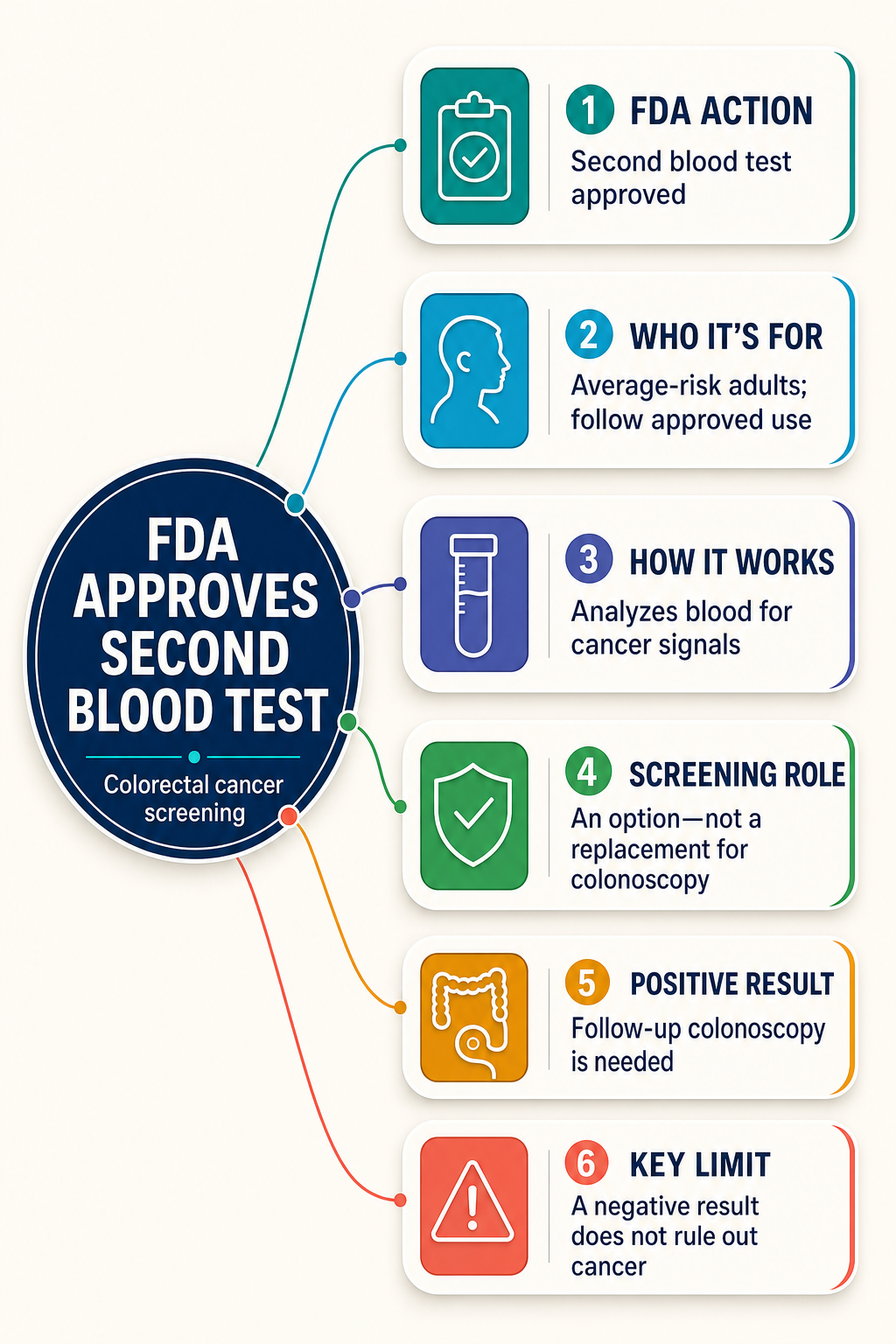
Guardant Health’s Shield provides another screening option for average-risk adults, but it detects relatively few advanced adenomas and every positive result requires colonoscopy.
✔ Quick Answer
- On July 29, 2024, the FDA approved Guardant Health’s Shield blood test for primary colorectal cancer screening in average-risk adults age 45 and older. [1]
- Shield may be described as the second FDA-approved blood-based colorectal cancer screening test when counted after Epi proColon, which received FDA approval in 2016 for a narrower population. [1,2]
- Reporting on the pivotal study cited colorectal cancer detection of just over 83%, but detection of only about 13% of advanced adenomas. [1]
- A positive Shield result is not a cancer diagnosis and must be followed by colonoscopy; a negative result does not exclude every cancer or precancerous lesion. [1]
Table of Contents
Background: Why Blood-Based Colorectal Cancer Screening Matters
Colorectal cancer remains a major cause of cancer mortality. A 2025 review reported that the United States remained below the National Colorectal Cancer Roundtable’s 80% screening target, with screening uptake reported at 59%. The review proposed that non-invasive blood-based tests could potentially increase screening, although that outcome has not yet been established for Shield in routine practice. [3]
Available colorectal cancer screening approaches include stool-based tests such as fecal immunochemical testing (FIT) and multitarget stool DNA testing, imaging-based tests, colonoscopy, and emerging blood-based tests. The American Cancer Society recommends beginning average-risk screening at age 45. [6]
What does “second blood test” mean?
Epi proColon, which detects methylated Septin9 DNA in plasma, received FDA approval in 2016 for average-risk patients who declined colonoscopy or FIT. Shield received FDA approval in 2024 for primary screening in average-risk adults age 45 and older. Counting Epi proColon makes Shield the second FDA-approved blood-based colorectal cancer screening test, although the tests have different technologies and indications. [1,2]
A blood draw may be more acceptable to some people than stool collection or colonoscopy. However, convenience does not make blood-based screening equivalent to colonoscopy or stool-based testing, particularly for detecting precancerous lesions. [1,2]
The New Evidence: What the Approval and Pivotal Study Showed
Medical News Today reported that the FDA approved Guardant Health’s Shield test for primary colorectal cancer screening on July 29, 2024. Shield uses cell-free DNA from a blood sample and is intended for average-risk adults age 45 and older. [1]
The report described a pivotal study involving almost 8,000 participants. Shield detected colorectal cancer with a reported success rate of just over 83%. [1]
Colorectal cancer detection
The pivotal-study coverage reported colorectal cancer detection of just over 83%. This means the test did not identify every cancer present in the study population. [1]
Advanced adenoma detection
The same coverage cited detection of only about 13% of advanced colon adenomas. These precancerous lesions were detected much less often than established colorectal cancer. [1]
Positive-result follow-up
A positive Shield result does not diagnose colorectal cancer. Colonoscopy is required to determine the cause of the abnormal result. [1]
Interpreting the reported performance
The available reporting cited an approximately 13% false-negative rate and approximately 10% false-positive rate. These estimates came from the reported study context and do not determine whether a particular person does or does not have cancer. [1]
Epi proColon’s earlier approval was more restricted. Medscape reported that it was indicated for average-risk patients who chose not to undergo colonoscopy or FIT. FDA advisers had expressed concerns about its effectiveness and benefit-risk balance, including that it did not perform better than FIT. [2]
Clinical Implications for Patients and Clinicians
Another option does not mean an equivalent option
Shield expands the available screening choices for average-risk adults. Its blood-draw format could be useful for people who otherwise do not complete screening, but the supplied evidence does not show that Shield has already increased national screening participation or reduced colorectal cancer mortality. [1,3]
The available tests also identify different targets with different levels of accuracy. Colonoscopy can detect and remove polyps during the procedure. Shield does not remove lesions and was reported to be less accurate than colonoscopy, multitarget stool DNA testing, and FIT for detecting advanced adenomas. [1]
Shield blood test
Uses a blood sample to screen average-risk adults age 45 and older. It does not detect every cancer, has limited detection of advanced adenomas, and requires colonoscopy after a positive result. [1]
Stool-based tests
FIT and multitarget stool DNA testing are established non-invasive options. Accuracy differs among tests and according to whether the target is cancer or an advanced precancerous lesion. [4,6]
Colonoscopy
A systematic review described colonoscopy as the most accurate screening test at a single application. It can detect and remove lesions, but it is invasive, can miss some lesions, and carries procedure-related risks. [4]
Use within the authorized population
The supplied reporting supports Shield for primary screening in average-risk adults age 45 and older. It does not establish the test as a diagnostic evaluation for symptoms or as a substitute for individualized surveillance or diagnostic pathways outside that population. [1]
Practical Takeaway: A Screening Decision Guide
1. Confirm screening eligibility
Average-risk colorectal cancer screening begins at age 45 under the American Cancer Society recommendation described in the supplied review. A healthcare professional can help determine whether average-risk screening applies. [6]
2. Compare available methods
Consider the differences among colonoscopy, FIT, multitarget stool DNA testing, imaging-based testing, and blood-based screening. Shield’s convenience must be weighed against its limited detection of advanced adenomas. [1,4,6]
3. Plan for an abnormal result
Before choosing Shield, determine how a positive result will be followed. Colonoscopy is required after a positive Shield result. [1]
Screening is a process
The process includes completing an appropriate screening test, receiving the result, and completing colonoscopy when a non-colonoscopy test is positive. A blood test alone cannot diagnose or exclude colorectal cancer. [1]
Coverage and out-of-pocket costs should be verified directly with the relevant insurer. The contemporaneous Medical News Today report contained conflicting information about the timing of Medicare coverage, so it should not be used as a current coverage determination. [1]
Evidence in Context: Limitations and Unanswered Questions
FDA approval supports Shield’s use for its authorized screening indication. It does not establish that Shield is interchangeable with colonoscopy, has closed the colorectal cancer screening gap, or has reduced colorectal cancer mortality in real-world use. [1,3]
Important evidence limitations
- Colorectal cancer detection was substantially stronger than detection of advanced adenomas. [1]
- False-negative results occur, so a negative result cannot exclude every colorectal cancer. [1]
- False-positive results occur and lead to colonoscopy, which has associated burdens and procedure-related risks. [1,4]
- The supplied reports do not establish long-term effects on colorectal cancer incidence or mortality. [1]
- The supplied reports do not demonstrate that Shield has already improved population-level screening participation. [1,3]
- Insurance coverage and affordability remain practical uncertainties and may change over time. [1,6]
Evidence supporting mortality reduction from colorectal cancer screening comes from established screening programs and cannot automatically be applied to Shield. A systematic review found a pooled 15% reduction in colorectal cancer mortality across four fecal occult blood testing trials at their last follow-up, while emphasizing that screening methods differ in accuracy and harms. [4]
Implementation also matters. Research on mailed FIT outreach found that health plans made substantial program adaptations according to their populations, settings, staffing, and financial incentives. That study addressed FIT outreach rather than Shield, but it illustrates that offering a test does not by itself establish broad uptake or successful follow-up. [5]
When to Consult a Doctor
Consult a healthcare professional if you are due for colorectal cancer screening, are uncertain whether you meet average-risk criteria, or need help comparing the available screening options.
Do not rely on an average-risk screening blood test to evaluate new symptoms. The supplied evidence addresses screening rather than diagnostic assessment of symptomatic patients. [1]
Frequently Asked Questions
Is Shield really the second FDA-approved blood test for colorectal cancer screening?
It is reasonable to describe Shield that way when counting Epi proColon, which received FDA approval in 2016. Shield was approved on July 29, 2024. The tests have different technologies and were not approved for identical populations. [1,2]
Can Shield replace colonoscopy?
Shield provides another primary screening option, but it does not replace colonoscopy when the blood-test result is positive. Colonoscopy can also detect and remove polyps, while Shield detected only about 13% of advanced adenomas in the reported pivotal study. [1,4]
Does a negative Shield result rule out colorectal cancer?
No. The supplied reporting cited an approximately 13% false-negative rate, so a negative result cannot exclude every colorectal cancer. It also does not establish that advanced precancerous lesions are absent. [1]
References
- Freeborn J. “New colorectal cancer blood test approved by FDA: What to know.” Medical News Today. August 5, 2024. Read the report
- Brooks M. “FDA Clears First Blood-Based Colorectal Cancer Screening Test.” Medscape. April 14, 2016. Read the report
- Cullison J. A Blood-Based Test for Colorectal Cancer Screening. HCA Healthcare Journal of Medicine. 2025;6(6):571-573. doi:10.36518/2689-0216.2259. View PubMed record
- Whitlock EP, Lin J, Liles E, et al. Screening for Colorectal Cancer: An Updated Systematic Review. Agency for Healthcare Research and Quality; 2008. View PubMed record
- Coronado GD, Schneider JL, Green BB, et al. Health plan adaptations to a mailed outreach program for colorectal cancer screening among Medicaid and Medicare enrollees: the BeneFIT study. Implementation Science. 2020;15(1):77. doi:10.1186/s13012-020-01037-4. View PubMed record
- Cortiana V, Joshi M, Chorya H, et al. Reimagining Colorectal Cancer Screening: Innovations and Challenges with Dr. Aasma Shaukat. Cancers. 2024;16(10):1898. doi:10.3390/cancers16101898. View PubMed record