

Alendronate is a prescription bisphosphonate used to treat and prevent osteoporosis and to reduce fracture risk. It works by slowing bone breakdown and is taken orally — typically once weekly — with strict administration instructions to minimise gastrointestinal side effects. Clinical evidence supports its ability to reduce hip, vertebral, and other clinical fractures in postmenopausal women with osteoporosis, with moderate to high certainty of evidence.
- Alendronate is a first-line oral bisphosphonate for osteoporosis and secondary fracture prevention [10].
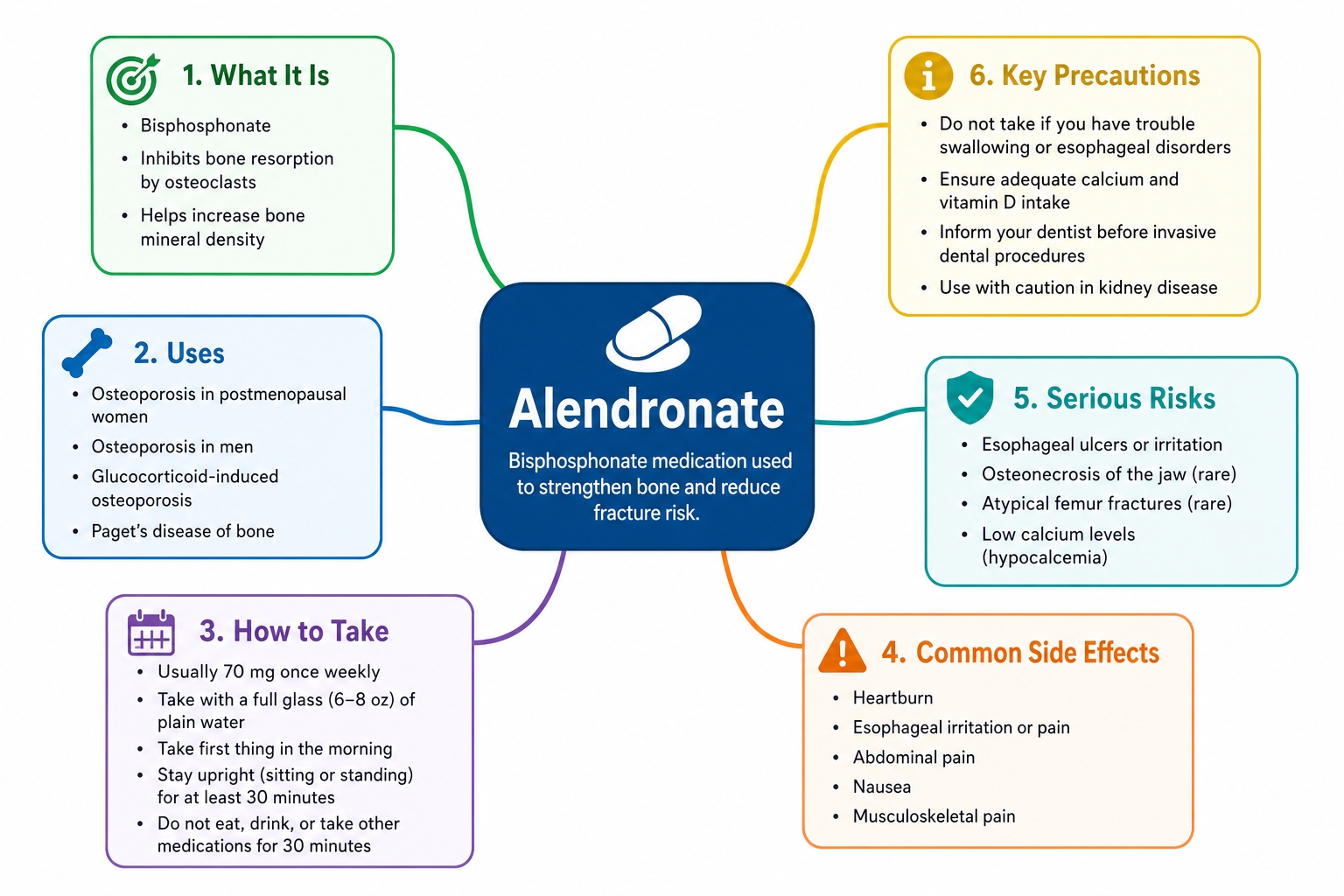
- It reduces bone resorption by inhibiting osteoclast activity, helping to maintain or increase bone mineral density.
- A systematic review found it reduces hip, vertebral, and other clinical fractures in postmenopausal women with osteoporosis (moderate to high certainty of evidence) [6].
- It must be taken on an empty stomach with a full glass of plain water; the patient must remain upright for at least 30 minutes afterward.
- Long-term use (three or more years) is associated with rare but serious risks including atypical femoral fractures and osteonecrosis of the jaw [6][9].
- Alendronate is generally not recommended during pregnancy or breastfeeding; it requires dose adjustment or avoidance in severe kidney disease.
If your doctor has told you that your bones are thinning — or if you have recently been diagnosed with osteoporosis — alendronate has likely come up in the conversation. It is one of the most widely prescribed bone medications globally, supported by decades of clinical trial data. Like every medication, however, it carries nuances that patients and carers benefit from understanding clearly.
What Is Alendronate?
Alendronate (brand name Fosamax, among others) belongs to the bisphosphonate drug class — medications designed to preserve bone mass by reducing its breakdown. It is available as an oral tablet and is used primarily to treat and prevent osteoporosis, a condition in which bones become porous and prone to fracture.
The drug is most commonly prescribed for postmenopausal women, because the drop in oestrogen after menopause accelerates bone loss. It is also approved for men with osteoporosis and for people whose bone loss is driven by long-term glucocorticoid (steroid) use [7]. Importantly, it is recommended as a first-line oral agent for secondary fracture prevention in adults aged 65 and older who have already experienced a hip or vertebral fracture [10].
Beyond its established clinical role, alendronate’s strong affinity for bone tissue has made it a useful targeting ligand in experimental drug-delivery research — for example, in nanoparticle platforms designed to direct therapies specifically to bone [1][3][4][5]. These applications are investigational and not part of current clinical practice.
How Does Alendronate Work?
Bone undergoes continuous remodelling, with osteoclasts (cells that break down old bone) and osteoblasts (cells that build new bone) normally working in balance. In osteoporosis, resorption outpaces formation, leading to progressive bone loss.
Alendronate binds with high affinity to hydroxyapatite crystals on the bone surface and is taken up by osteoclasts during their resorbing activity. Inside the cell, it disrupts a key metabolic pathway, reducing osteoclast function and survival. The result is slower bone breakdown, allowing bone mineral density (BMD) to stabilise or improve [6][9].
Critically, alendronate does not directly stimulate new bone formation — it preserves existing bone. Because bisphosphonates bind tightly to bone, they can persist in skeletal tissue for years after treatment is stopped [9]. This prolonged retention underpins both the drug’s sustained benefit after cessation and the rationale for planned treatment breaks (“drug holidays”) in long-term users.
What Conditions Does Alendronate Treat?
- Postmenopausal osteoporosis (treatment) — The most common use. Reduces risk of spine, hip, and other clinical fractures [6].
- Postmenopausal osteoporosis (prevention) — Started earlier in women at elevated risk who do not yet meet diagnostic criteria for osteoporosis.
- Osteoporosis in men — Approved for men with confirmed low bone density or osteoporosis [7].
- Glucocorticoid-induced osteoporosis — For people on long-term steroid therapy that accelerates bone loss.
- Paget’s disease of bone — A condition of disorganised bone remodelling, treated with higher doses.
- Secondary fracture prevention — Recommended as a first-line oral agent for older adults who have already sustained a hip or vertebral fracture [10].
In experimental settings, the molecule’s bone-targeting properties have been exploited in research platforms — including alendronate-coated nanoparticles for osteosarcoma immunotherapy [3], a stalactite-inspired composite for peri-implantitis [4], silk fibroin hydrogels for rotator cuff repair [5], and piezoelectric microspheres for systemic bone remodelling [1]. None of these applications are in current clinical use.
Dosage and How to Take It
Alendronate has specific, non-negotiable administration requirements. Incorrect technique is a leading cause of both reduced efficacy and avoidable side effects.
Typical doses (follow your prescriber’s exact instructions):
- Osteoporosis treatment: 70 mg once weekly, or 10 mg once daily
- Osteoporosis prevention: 35 mg once weekly, or 5 mg once daily
- Paget’s disease: Higher doses (typically 40 mg daily for six months — confirm with prescriber)
How to take it correctly:
- Take it first thing in the morning, before any food, drink (other than plain water), or other medications
- Swallow with a full glass (approximately 200 mL) of plain water only — not coffee, juice, tea, or mineral water
- Stay upright (sitting or standing) for at least 30 minutes after taking it — do not lie down
- Do not eat or drink anything (other than plain water) for at least 30 minutes after the dose
- Do not crush, chew, or suck the tablet — swallow it whole
These instructions exist because alendronate can be highly irritating to the oesophagus. Taking it with an insufficient volume of water, or lying down afterwards, substantially increases the risk of oesophageal irritation or ulceration. If you miss a weekly dose, take it the morning after you remember and then return to your regular weekly schedule — do not take two doses on the same day.
Side Effects of Alendronate
Most people tolerate alendronate adequately, particularly with once-weekly dosing. Awareness of what to expect helps patients distinguish normal adjustment from signals that need medical attention.
Common side effects:
- Heartburn or acid reflux
- Nausea or stomach upset
- Abdominal pain or discomfort
- Musculoskeletal pain (muscle, joint, or bone pain)
- Headache
- Constipation or diarrhoea
These are generally mild and are closely linked to adherence to administration instructions. Correct technique substantially reduces gastrointestinal complaints.
Serious but less common side effects:
- Oesophageal ulcers or irritation — Usually attributable to incorrect administration
- Atypical femoral fractures (AFFs) — Paradoxical fractures of the thigh bone associated with long-term use (three or more years); absolute risk is low [6][9]
- Osteonecrosis of the jaw (ONJ) — Rare; more common in cancer patients receiving high doses than in osteoporosis patients [9]
- Severe musculoskeletal pain — In some cases debilitating; typically resolves after stopping the drug
- Hypocalcaemia — Low blood calcium; more likely if calcium and vitamin D intake are inadequate
- Ocular inflammation — Rare cases of uveitis, episcleritis, scleritis, and conjunctivitis have been documented with amino-bisphosphonates including alendronate; symptoms often resolve after discontinuation, but may recur on rechallenge [8]
The mechanism underlying atypical femoral fractures is not fully established, but the leading hypothesis is that prolonged suppression of bone turnover may impair the normal repair of micro-cracks, allowing them to accumulate. This is part of the rationale for considering planned drug holidays after several years of therapy [9].
- Difficulty swallowing, pain on swallowing, or severe chest pain after taking the tablet
- New or unusual thigh, hip, or groin pain (possible atypical femoral fracture warning)
- Jaw pain, swelling, or exposed bone in the mouth
- Sudden eye redness, pain, or changes in vision [8]
- Muscle cramps, numbness, or tingling (possible hypocalcaemia)
- Severe or unexpectedly worsening bone or joint pain
Who Should Not Take Alendronate?
Alendronate is not appropriate for everyone. A thorough medical history is necessary before starting treatment.
Contraindications:
- Oesophageal abnormalities that delay emptying (e.g., stricture, achalasia)
- Inability to sit or stand upright for at least 30 minutes
- Uncorrected hypocalcaemia (blood calcium must be normalised before starting)
- Severe kidney disease (creatinine clearance below 35 mL/min)
- Known hypersensitivity to alendronate or any component of the formulation
Use with caution in:
- Older adults — Higher risk of gastrointestinal complications; ensuring adequate calcium and vitamin D is particularly important [7]
- People with active upper gastrointestinal conditions — Gastritis, peptic ulcer disease, or oesophageal disorders increase risk
- Mild-to-moderate kidney disease — May require monitoring; review with prescriber
- Patients with planned invasive dental procedures — ONJ risk, although low in osteoporosis dosing, should be discussed with the dental team [9]
Drug Interactions
Timing is critical when other medications or supplements are taken alongside alendronate.
- Calcium supplements, antacids, and dairy products — Bind to alendronate in the gut and substantially reduce its absorption. Wait at least 30–60 minutes after taking alendronate before taking any of these.
- NSAIDs (e.g., ibuprofen, naproxen, aspirin) — Combined use may increase the risk of gastrointestinal irritation and ulceration.
- Iron supplements and multivitamins containing minerals — Can impair absorption similarly to calcium; take later in the day.
- Other bisphosphonates — Should not be combined; no evidence of additive benefit and increased risk of adverse effects.
- Aminoglycosides — May increase the risk of hypocalcaemia when used concurrently.
The practical rule: alendronate should be taken alone, first thing in the morning, before all food, drinks (other than plain water), and other medications.
Alendronate in Pregnancy and Breastfeeding
Alendronate should generally not be used during pregnancy. Because bisphosphonates bind strongly to bone and have a prolonged skeletal half-life, there is theoretical concern about effects on fetal bone development; animal studies have demonstrated fetal accumulation. Women of childbearing age who are prescribed alendronate should use effective contraception, and the drug should be discontinued if pregnancy is planned or confirmed. The timing of stopping before a planned pregnancy may be relevant given long bone retention — this requires an individualised discussion with the prescribing clinician.
Data on alendronate during breastfeeding are very limited. Given its strong bone affinity, circulating maternal blood levels — and therefore breast milk levels — are expected to be low after skeletal binding; however, robust safety data are absent. Alendronate is generally not recommended during breastfeeding. Any decision must involve a careful risk–benefit discussion with the prescriber.
Long-Term Use: Benefits and Risks
Long-term bisphosphonate therapy presents a genuine clinical balancing act. On the benefit side, extended use of alendronate (up to 10 years in the FLEX trial) has been associated with continued gains in bone mineral density and sustained vertebral fracture risk reduction [9]. On the risk side, both atypical femoral fractures and osteonecrosis of the jaw are more common with higher cumulative doses and longer treatment durations, though the absolute risks remain low [6][9].
Because of this, many guidelines suggest reassessing the need for continued therapy after three to five years. For some patients at lower ongoing fracture risk, a planned drug holiday may be appropriate; for those at high ongoing risk, continuation is often favoured. This decision should always be individualised [9][10].
Evidence in Context
The evidence base for alendronate is substantial but has recognised limitations that patients and clinicians should understand.
What the evidence shows clearly: A 2023 living systematic review and network meta-analysis commissioned by the American College of Physicians — covering 34 RCTs in 100 publications and 36 observational studies — found that bisphosphonates reduce hip, clinical vertebral, and other clinical fractures in postmenopausal women with osteoporosis (moderate to high certainty of evidence) [6]. The same review confirmed that long-term bisphosphonate use (36 months or more) may increase AFF and ONJ risk, but that absolute risks are low [6]. A 2023 review of long-term bisphosphonate data, including FLEX and HORIZON extension trials, further supports sustained BMD gains and fracture reduction with extended alendronate and zoledronate use [9].
Where evidence is weaker: The ACP review noted that few studies have examined outcomes in people with low bone mass (rather than frank osteoporosis), in men, in Black-identifying individuals, or in those on sequential therapy or treatment beyond three years [6]. Evidence in men comes primarily from smaller trials and is of lower certainty [6][7]. Optimal treatment duration and the best criteria for initiating a drug holiday remain areas of active debate.
Emerging and experimental research: Several 2026 studies used alendronate as a bone-targeting ligand in experimental platforms — including piezoelectric microspheres for osteoporosis [1], nanoparticles for osteosarcoma immunotherapy [3], and hydrogels for rotator cuff repair [5]. A mouse study examined how bisphosphonate treatment interacts with mechanical unloading across age groups, finding that bisphosphonate treatment did not prevent disuse-related muscle mass loss and that myostatin levels increased with bisphosphonate treatment and unloading [2]. These findings are from preclinical or early experimental models and have no direct implications for current clinical prescribing practice.
What remains unknown: The precise thresholds for AFF and ONJ risk based on cumulative dose, the ideal duration of drug holidays, long-term outcomes in men and younger premenopausal women, and how bisphosphonate effects interact with age-related muscle changes in clinical populations [2][9].
Safety Tips and Practical Guidance
- Ensure adequate calcium and vitamin D intake — These are necessary for alendronate to work correctly and to prevent hypocalcaemia. Your doctor may recommend supplements.
- Inform your dentist — Especially before any invasive dental work. ONJ risk in osteoporosis dosing is low but relevant [9].
- Discuss treatment duration with your doctor — After three to five years, reassessment of ongoing need is recommended [9][10].
- Do not stop abruptly without medical advice — Though alendronate’s effects persist to some degree after stopping due to bone retention, abrupt unsupervised discontinuation is not advisable.
- Maintain weight-bearing exercise — Physical activity complements pharmacological bone preservation. Preclinical research suggests exercise may interact with bisphosphonate effects on bone, though the clinical implications across age groups are still being characterised [2].
- Report thigh or groin aching promptly — New aching in these areas can be a prodromal warning of atypical femoral fracture and should prompt early evaluation.
- Attend bone density monitoring — DEXA scanning at intervals determined by your clinician allows assessment of treatment response.
- Is my bone density low enough to need alendronate, or would lifestyle changes alone be sufficient for now?
- How long do you anticipate I will need this medication, and when will we reassess?
- Should I take a calcium or vitamin D supplement alongside alendronate, and if so, how much?
- Should I tell my dentist before scheduling any procedures? What should I watch for regarding my jaw?
- What symptoms should prompt me to contact you between appointments?
- At what point would you consider a drug holiday, and what does that involve?
- Are there alternative treatments — oral or intravenous — that might better suit my situation?
Conclusion
Alendronate occupies a well-established place in osteoporosis management, supported by a substantial body of clinical trial evidence. A 2023 systematic review found it reduces hip, vertebral, and other clinical fractures in postmenopausal women with osteoporosis with moderate to high certainty of evidence [6], and long-term data support continued BMD gains with extended use [9]. It is recommended as a first-line oral treatment for secondary fracture prevention in older adults [10].
At the same time, the administration requirements are demanding, the monitoring needs are real, and the decision about how long to continue — or when to pause — requires ongoing clinician input. For most people, the benefit-to-risk balance favours treatment when there is genuine fracture risk, but that balance should be reviewed regularly. Patients who understand what alendronate does, how to take it correctly, and what to watch for are better placed to get the most from it safely.
References
- Han W, et al. A motion-activated skeletal “Pacemaker” for systemic bone remodeling via oral piezoelectric microspheres. Bioact Mater. 2026;65:311–332. doi:10.1016/j.bioactmat.2026.05.051
- Orr SV, et al. Age-dependent musculoskeletal changes during mechanical unloading with bisphosphonate treatment. Bone. 2026;210:117924. doi:10.1016/j.bone.2026.117924
- Tong Z, et al. Manganese-potentiated cGAS-STING activation with ATM/PRMT5 inhibition remodels the immunosuppressive microenvironment in osteosarcoma via bone-targeted delivery. Bioact Mater. 2026;63:117–135. doi:10.1016/j.bioactmat.2026.03.032
- Zhou Z, et al. A stalactite-inspired NIR/pH-responsive visualizable nano-platform for microenvironment-activated therapy of peri-implantitis-induced bone defects. Bioact Mater. 2026;63:221–238. doi:10.1016/j.bioactmat.2026.03.005
- Yang T, et al. Strontium-based metal-organic framework/alendronate-silk fibroin hydrogels promote tendon-bone interface healing. Mol Med Rep. 2026;34(2):226. doi:10.3892/mmr.2026.13936
- Ayers C, et al. Effectiveness and safety of treatments to prevent fractures in people with low bone mass or primary osteoporosis: a living systematic review and network meta-analysis for the American College of Physicians. Ann Intern Med. 2023;176(2):182–195. doi:10.7326/M22-0684
- Srivastava M, Deal C. Osteoporosis in elderly: prevention and treatment. Clin Geriatr Med. 2002;18(3):529–555. doi:10.1016/s0749-0690(02)00022-8
- Chartrand NA, et al. Ocular side effects of bisphosphonates: a review of literature. J Ocul Pharmacol Ther. 2023;39(1):3–16. doi:10.1089/jop.2022.0094
- Gehrke B, et al. Long-term consequences of osteoporosis therapy with bisphosphonates. Arch Endocrinol Metab. 2023;68:e220334. doi:10.20945/2359-4292-2022-0334
- Conley RB, et al. Secondary fracture prevention: consensus clinical recommendations from a multistakeholder coalition. J Bone Miner Res. 2020;35(1):36–52. doi:10.1002/jbmr.3877