

- Alfuzosin is approved for BPH-related lower urinary tract symptoms (LUTS) in men and is also a guideline-supported option for CP/CPPS with urinary symptoms.[6,10]
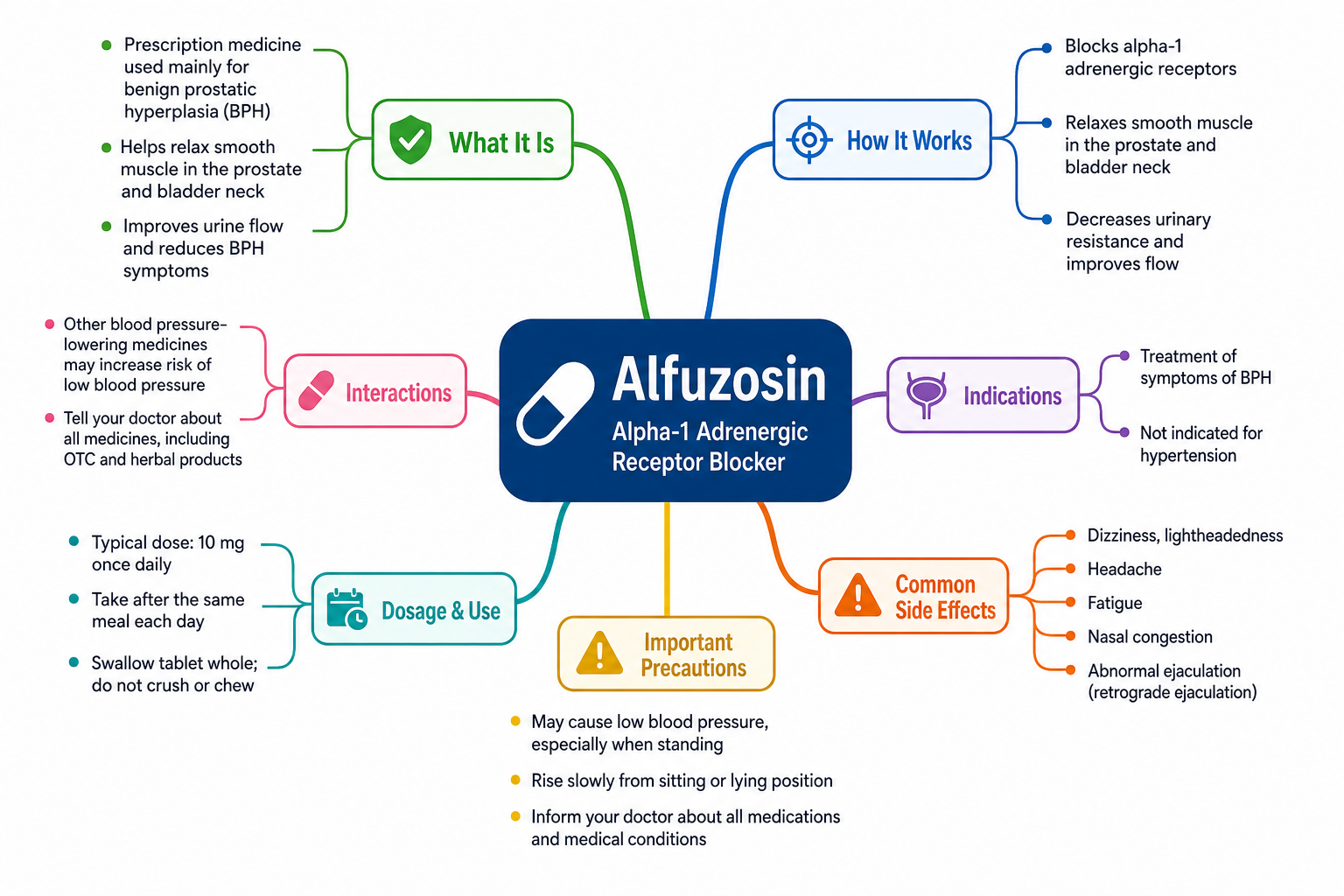
- The standard dose is 10 mg once daily as an extended-release tablet, taken with the evening meal.
- Compared with some other alpha-blockers, alfuzosin appears to have a lower rate of ejaculatory dysfunction, which may be relevant for sexually active men.[7,10]
- It can cause dizziness and orthostatic hypotension, particularly in the first days of treatment and in older patients.[1]
- Men scheduled for cataract surgery should inform their ophthalmologist, as alpha-blockers are associated with intraoperative floppy iris syndrome (IFIS).
- Alfuzosin is associated with rare instances of clinically apparent acute liver injury.[8]
- Pharmacovigilance data raise a possible — but unconfirmed and not causal — signal linking alfuzosin to dementia risk; monitoring cognitive status in older patients on long-term therapy is advisable.[3]
- Alfuzosin is not indicated for women or children.
What Is Alfuzosin?
Alfuzosin (brand name: Uroxatral in the US, approved 2003) is a quinazoline-derivative alpha-1 adrenergic receptor antagonist.[9] Although classified as a non-selective alpha-1 blocker, it exhibits preferential concentration in prostatic tissue relative to plasma in patients with BPH, which is thought to underlie its urological selectivity.[10]
Alpha-blockers as a class inhibit alpha-1 adrenergic receptors in smooth muscle, reducing muscle tone in the prostate, bladder neck, and vascular walls. Selective alpha-1a receptor antagonists (tamsulosin, silodosin) were developed later and are claimed to carry less blood-pressure risk than non-selective agents; alfuzosin occupies an intermediate position, concentrating at the urinary level while retaining some vascular activity.[9,10]
Alfuzosin is prescribed for adult men with BPH-related LUTS. It is not used in women or children, and it is not a first-line antihypertensive agent in current guidelines.[9]
How Does Alfuzosin Work?
The prostate surrounds the urethra; when it enlarges, increased smooth-muscle tone at the prostate and bladder neck narrows the urethral lumen and obstructs urine flow. Alfuzosin blocks alpha-1 adrenergic receptors in that smooth muscle, reducing tone and allowing urine to pass more freely. It does not reduce prostate volume.
Because alpha-1 receptors are also present in arterial walls, alfuzosin can lower blood pressure — the basis for the hypotension and dizziness that some patients experience.[9]
The 10 mg extended-release tablet uses a three-layered matrix that releases the drug over approximately 20 hours, enabling once-daily dosing with stable plasma levels.[10] The tablet must be swallowed whole; breaking or crushing it eliminates the controlled-release mechanism.
Approved and Evidence-Supported Uses
1. Benign Prostatic Hyperplasia with LUTS
This is alfuzosin’s primary FDA-approved indication. Three registration trials and multiple randomised controlled trials have assessed its safety and efficacy for BPH/LUTS, demonstrating improvements in urinary flow rate and symptom scores.[10] A 2021 systematic review and narrative synthesis confirmed effectiveness as monotherapy and in combination with 5-alpha reductase inhibitors, antimuscarinics, and phosphodiesterase-5 inhibitors (PDE5i).[10]
2. Chronic Prostatitis / Chronic Pelvic Pain Syndrome (CP/CPPS)
A 2025 JAMA review of prostatitis management identified alpha-blockers — including alfuzosin — as first-line oral therapy for CP/CPPS with urinary symptoms, citing a NIH Chronic Prostatitis Symptom Index (NIH-CPSI) score difference versus placebo of −10.8 to −4.8 points (a 6-point change is considered clinically meaningful).[6]
3. Ureteral Stent-Related Symptoms (Investigational)
A 2026 prospective randomised trial in 103 patients compared alfuzosin 10 mg/day, mirabegron 50 mg/day, combination therapy, and no medication following Double-J stent placement after retrograde intrarenal surgery. The alfuzosin group had numerically lower pain and overactive bladder scores, but no statistically significant differences were found between any group for stent-related pain, LUTS, or stone-free rates (p > 0.05).[4] The authors noted the small sample size and single-centre design as key limitations and called for larger multicentre studies.[4]
4. Ejaculatory Function in Sexually Active Men
A 2021 systematic review of six cohort studies (n = 1,371; median age 62.3 years) found that alfuzosin was associated with a median decrease in International Prostate Symptom Score (IPSS) of 6.6 points and a median increase in Male Sexual Health Questionnaire–Ejaculatory Dysfunction (MSHQ-EjD) Short Form score of 1.9 points, suggesting modest preservation or improvement of ejaculatory function alongside LUTS relief.[7] The authors concluded that alfuzosin should be considered in men who are sexually active or who already report deteriorating ejaculation, while acknowledging that all included studies were cohort designs, not randomised trials.[7]
Dosage and Administration
Standard adult dose: 10 mg once daily as an extended-release tablet.
Timing and food: Take immediately after the same meal each day — the evening meal is typically recommended. Food increases and stabilises absorption; taking alfuzosin on an empty stomach raises the risk of orthostatic hypotension.[10]
Swallow whole. Do not crush, chew, or split the tablet.
Additional practical points:
- If a dose is missed, take it with the next meal — do not double the dose to compensate.
- Symptom improvement may take two to four weeks; do not discontinue prematurely without consulting your prescriber.
- Do not stop the medication abruptly without medical guidance.
These are general principles. Follow your prescribing clinician’s specific instructions.
Side Effects
Common Side Effects
- Dizziness or lightheadedness — particularly on standing (orthostatic hypotension)
- Fatigue
- Headache
- Nasal congestion
- Abdominal discomfort
These effects reflect alfuzosin’s vascular smooth-muscle relaxation. Orthostatic hypotension is most pronounced with the first dose and in older patients. A large FAERS pharmacovigilance analysis found that patients aged 65–80 years accounted for the majority of adverse event reports, and most adverse events occurred within 30 days of starting treatment.[1]
Serious or Clinically Important Side Effects
- Intraoperative Floppy Iris Syndrome (IFIS): A well-documented complication during cataract surgery, associated with alpha-1 blocker use. A 2026 ophthalmology study examining anterior segment and pupillary changes found that alfuzosin (along with tamsulosin and silodosin) did not significantly alter static or dynamic pupil size under most conditions in their sample, unlike doxazosin, which produced significantly smaller pupil diameters.[5] Regardless, always inform your eye surgeon and anaesthesiologist before any ocular procedure.
- Severe hypotension: More likely in elderly patients or those on antihypertensive medications.[1]
- Liver injury: Alfuzosin is associated with a low rate of transient serum aminotransferase elevations and rare instances of clinically apparent acute liver injury.[8]
- QT prolongation / cardiac arrhythmia: Rare; of greater concern in patients with pre-existing cardiac conditions or on other QT-prolonging agents.
- Possible cognitive effects: A FAERS pharmacovigilance analysis identified a reporting signal associating both alfuzosin and tamsulosin with dementia, but the authors explicitly noted that further research is required to clarify this relationship and called for monitoring of cognitive status in at-risk patients.[3] Signal-detection studies cannot establish causation and are subject to confounding by age and comorbidity.
- Priapism: A prolonged, painful erection. Rare, but requires emergency medical attention.
Contraindications and Cautions
Absolute Contraindications
- Known hypersensitivity to alfuzosin or any tablet component
- Severe hepatic impairment — alfuzosin is extensively hepatically metabolised; liver failure markedly raises drug exposure and toxicity risk[8]
- Concomitant use of potent CYP3A4 inhibitors (e.g., ketoconazole, itraconazole, ritonavir) — these substantially increase alfuzosin plasma levels
- Concurrent use of another alpha-1 blocker
Situations Requiring Extra Caution
- Elderly men: Greater susceptibility to falls and syncope from orthostatic hypotension; the majority of FAERS adverse event reports involved patients aged 65–80 years, with most events occurring in the first 30 days of treatment.[1]
- Moderate hepatic impairment: Use with caution; contraindicated in severe impairment.[8]
- Renal impairment: Discuss dose appropriateness with your prescriber.
- Pre-existing QT prolongation or concurrent QT-prolonging drugs: Requires cardiac assessment.
- Planned cataract surgery: Inform your ophthalmologist and anaesthesiologist before any ocular procedure due to IFIS risk.
Drug Interactions
- Antihypertensives: Additive blood-pressure lowering increases the risk of symptomatic hypotension and falls.
- PDE5 inhibitors (sildenafil, tadalafil, vardenafil): Both drug classes lower blood pressure; combination use carries a meaningful risk of severe hypotension and requires careful medical supervision.[10]
- Potent CYP3A4 inhibitors (ketoconazole, itraconazole, ritonavir, clarithromycin): Contraindicated — these agents markedly increase alfuzosin plasma concentrations.
- Other alpha-blockers: No additional benefit and compounded hypotension risk.
- Anaesthetic agents: Alfuzosin can potentiate blood-pressure-lowering effects; disclose use to your anaesthesiologist before any procedure.
Always provide your doctor and pharmacist with a complete list of all medications — prescription, over-the-counter, and herbal — before starting alfuzosin.
Use in Women, Pregnancy, and Breastfeeding
Alfuzosin has no approved indication in women and has not been studied in pregnancy or breastfeeding populations. It should not be used by women.
Practical Safety Guidance
Before Starting
- Disclose all medications and supplements to your prescriber.
- Inform your prescriber of any history of liver disease, cardiac arrhythmias, or low blood pressure.
- If cataract surgery is planned, tell your ophthalmologist — IFIS risk persists even after discontinuation.
While Taking Alfuzosin
- Rise slowly from sitting or lying positions, especially in the first days and after any dose change.
- Avoid alcohol, which compounds dizziness and blood pressure effects.
- Exercise caution when driving or operating machinery until you know how the medication affects you.
- In older patients on long-term therapy, periodic cognitive status monitoring is reasonable given the unresolved pharmacovigilance signal.[3]
Seek Prompt Medical Attention If You Develop:
- Fainting or near-fainting
- Chest pain or rapid/irregular heartbeat
- Yellowing of the skin or eyes (possible liver injury)[8]
- A prolonged painful erection lasting more than 4 hours
- Sudden severe dizziness that prevents you from standing safely
The strongest evidence for alfuzosin comes from randomised controlled trials and systematic reviews establishing efficacy for BPH/LUTS[10] and from a 2025 JAMA review supporting its role in CP/CPPS.[6] The 2021 systematic review of ejaculatory function data[7] is informative but relies on cohort studies rather than randomised designs.
Two areas carry meaningful uncertainty. First, a FAERS pharmacovigilance analysis detected a reporting signal linking both alfuzosin and tamsulosin to dementia, but the authors explicitly stated this requires further research and cannot establish causation; confounding by age, indication, and comorbidity is a substantial concern in such observational data.[3] Second, a 2026 randomised trial of alfuzosin for Double-J stent-related symptoms found no statistically significant benefit over control, and its small single-centre design limits conclusions.[4]
The 2026 ophthalmology study found no significant anterior segment or pupil changes for alfuzosin compared to controls, in contrast to doxazosin, which produced significantly smaller pupils — though IFIS risk during surgery remains a recognised concern for all alpha-blockers and warrants disclosure to surgical teams regardless.[5]
Remaining gaps: Long-term cognitive effects, optimal treatment duration, and comparative effectiveness against newer selective alpha-1a agents in specific patient subgroups require further prospective study.
- Is my blood pressure stable enough to safely add an alpha-blocker?
- Do any of my current medications interact with alfuzosin?
- I am sexually active — will this affect my ejaculatory function compared with other options?
- I have cataract surgery scheduled — should I delay starting alfuzosin and what should I tell my eye surgeon?
- How long should I expect to take this medication, and what would prompt a review?
- What symptoms should lead me to contact you or stop the medication?
References
- Zhao Z, Wu C, Xiong Y, et al. Evaluating the safety profile of α-1 blockers, 5α-reductase inhibitors, and PDE5I for BPH: a disproportionality analysis of real-world adverse events based on FDA adverse event reporting system (FAERS). Aging Male. 2026;29(1):2647019. doi:10.1080/13685538.2026.2647019. PMID: 41876378.
- Correction to “Efficacy of Serenoa repens Extract Combined With Alfuzosin Versus Alfuzosin Alone in Men With Lower Urinary Tract Symptoms Due to Benign Prostatic Hyperplasia.” Prostate. 2026;86(7):846–847. doi:10.1002/pros.70141. PMID: 41664556.
- Wang Y, Kong J, Yang Y, Zheng Y, Li J. Drug-induced dementia: a pharmacovigilance analysis of the FAERS database. Expert Opin Drug Saf. 2026;25(5):949–956. doi:10.1080/14740338.2024.2443106. PMID: 39673546.
- Öztürk M, Taskir F, Erturhan S, et al. Comparison of the efficacy of alfuzosin and mirabegron on symptoms associated with Double-J stent placement after retrograde intrarenal surgery. Urol Ann. 2026;18(2):141–147. doi:10.4103/ua.ua_91_25. PMID: 42088134.
- Birgul R, Akbay EK, Demirtaş AA, Daldal H. Anterior segment, static and dynamic pupillography changes in patients using different types of alpha-1 blockers. Doc Ophthalmol. 2026 Mar 9. doi:10.1007/s10633-026-10094-x. PMID: 41801324.
- Borgert BJ, Wallen EM, Pham MN. Prostatitis: A Review. JAMA. 2025;334(11):1003–1013. doi:10.1001/jama.2025.11499. PMID: 40788632.
- Yeung HEL, Sena SJ, Calopedos RJ, Woo HH. Alfuzosin and Its Effect on Ejaculatory Dysfunction: A Systematic Review. World J Mens Health. 2021;39(2):186–194. doi:10.5534/wjmh.180024. PMID: 32009306.
- National Institute of Diabetes and Digestive and Kidney Diseases. Alfuzosin. In: LiverTox: Clinical and Research Information on Drug-Induced Liver Injury [Internet]. Bethesda (MD): NIDDK; 2018 Jan 8. PMID: 31644057.
- National Institute of Diabetes and Digestive and Kidney Diseases. Alpha 1 Adrenergic Receptor Antagonists. In: LiverTox: Clinical and Research Information on Drug-Induced Liver Injury [Internet]. Bethesda (MD): NIDDK; 2018 Jan 8. PMID: 31644028.
- Mari A, Antonelli A, Cindolo L, et al. Alfuzosin for the medical treatment of benign prostatic hyperplasia and lower urinary tract symptoms: a systematic review of the literature and narrative synthesis. Ther Adv Urol. 2021;13:1756287221993283. doi:10.1177/1756287221993283. PMID: 33912246.